
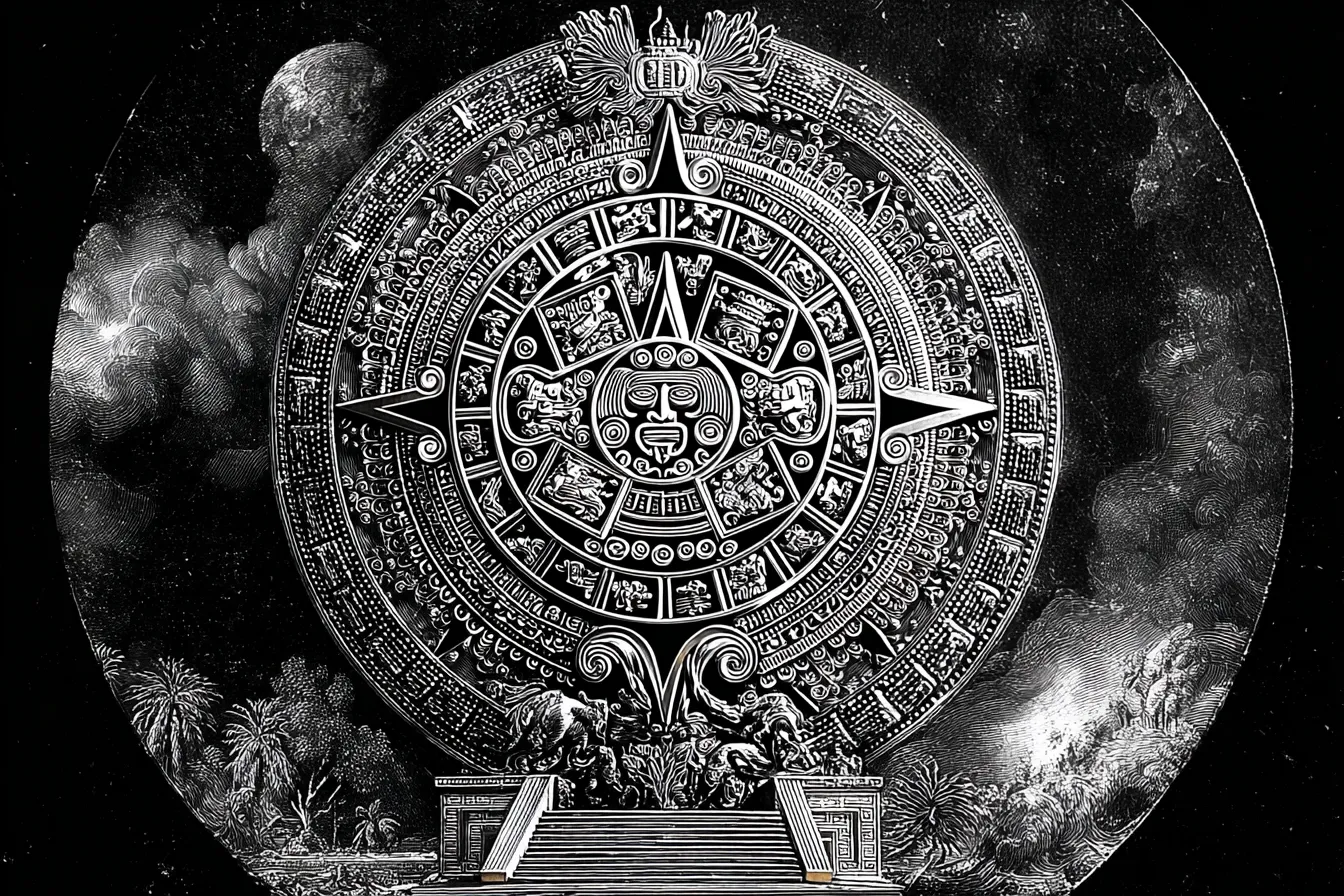
When most people picture the Aztec calendar, they picture the famous Sun Stone — the massive circular basalt disk carved in the late 15th century, now housed in the National Museum of Anthropology in Mexico City. What most people don’t know is that the Sun Stone is not primarily a calendar at all. It’s a cosmological monument representing the Five Suns (five successive world ages in Aztec cosmology). The Aztec calendar used for daily life and for birth divination was something more intimate and more sophisticated: the Tonalpohualli.
The Tonalpohualli (from Nahuatl: tonalli, “day/fate/warmth” + pohualli, “count”) is the 260-day ceremonial cycle that the Aztecs shared — in structure if not in name — with the Maya and every other major Mesoamerican civilization. It runs 20 named day signs × 13 numbered tones = 260 unique day signatures. Your birthday falls on one of those 260 days, and in the traditional Aztec framework, the sign and tone of your birth day described the conditions you entered at birth: the energy of your moment of arrival into the world.
The Tonalpohualli and the Tzolkin: Related but Distinct
Before going further, a clarification that matters: the Aztec Tonalpohualli and the Maya Tzolkin are structurally identical — both use a 20 × 13 = 260 day cycle with named day signs and numbered tones — but they are not the same calendar. They share a common Mesoamerican origin estimated to be at least 2,600 years old, possibly much older. Over the centuries, the two traditions developed distinct iconographies, distinct correlations to the Gregorian calendar, and somewhat different interpretive frameworks.
The key practical difference: the traditional Tzolkin correlation (GMT) and the standard Tonalpohualli correlation produce different day sign assignments for the same Gregorian birth date. A person who is born on a particular day may be Imix in the Tzolkin and Cipactli in the Tonalpohualli (which are the same position — both are Sign 1 — but the day they fall on differs by the correlation). For people exploring Mesoamerican divination, it’s worth knowing which calendar is being used and which correlation is being applied.
The Whisper uses the GMT correlation for the Tzolkin and the standard correlation for the Tonalpohualli as separate systems — they appear as two distinct voices in the multi-system synthesis, offering two angles on the same 260-day cycle tradition.
The 20 Aztec Day Signs
The Aztec day signs have Nahuatl names and Aztec iconography, but correspond directly to the 20 Mayan Solar Seals in sequence. Understanding the Nahuatl character of each sign adds a distinct dimension — the Aztec cosmological framework emphasizes different aspects of each day’s quality than the Maya tradition does.
1. Cipactli (Caiman / Crocodile) — the primordial earth-creature, the source. In Aztec cosmology, Cipactli’s body became the earth after the primordial gods tore it apart to create the world. The sign carries foundational creative energy — origins, nourishment, the body of the world itself.
2. Ehecatl (Wind) — the wind god, associated with Quetzalcoatl in his wind aspect. Ehecatl sweeps the way clean before the rain. The sign carries communication, spirit, and the power of breath. The Aztec tradition emphasizes Ehecatl’s role as the herald — the energy that announces what’s coming.
3. Calli (House) — the house, the interior, the night sky. Where the Maya tradition emphasizes the darkness of the inner chamber (Akbal), the Aztec tradition emphasizes the house as shelter and container. Calli carries the energy of interior space, of what is protected and private.
4. Cuetzpallin (Lizard) — the lizard, associated with fertility and abundance. The lizard’s regenerative quality — the tail that grows back — is central to Cuetzpallin’s meaning: renewal through what seems like loss.
5. Coatl (Serpent) — the serpent, connected to Quetzalcoatl and to the earth’s vital force. The Aztec serpent is more explicitly cosmological than the Maya Chicchan — Coatl connects to the celestial serpent, the great feathered and unfeathered snakes that animate Aztec cosmology.
6. Miquiztli (Death / Skull) — death and the skull, associated with Mictlantecuhtli, the lord of the underworld. In the Aztec framework, Miquiztli’s death-energy is more explicitly structured than Maya Cimi’s worldbridging quality — it maps to a specific cosmological domain, the realm of the dead, and carries the energy of the necessary transition between realms.
7. Mazatl (Deer) — the deer, associated with the hunting god Mixcoatl and with the agricultural calendar. The deer in Aztec tradition carries the energy of graceful navigation and awareness — the deer that moves through the forest without disturbing it.
8. Tochtli (Rabbit) — the rabbit, strongly associated in Aztec tradition with pulque (fermented agave drink), abundance, and the cycles of the moon. The rabbit is one of the most multiply-referenced animals in Aztec iconography; Tochtli carries a quality of fertility, of lunar rhythm, and of the abundance that comes in cycles.
9. Atl (Water) — water itself, associated with Tlaloc, the great rain god. Where the Maya Muluc emphasizes the emotional body’s intelligence and universal memory, the Aztec tradition’s Atl emphasizes water’s agricultural and cosmological power — the rain that makes life possible, the flood that destroys, the offering that connects the human to the divine.
10. Itzcuintli (Dog) — the dog, guide through the underworld. In Aztec tradition, the hairless Xoloitzcuintli dog guides the soul through Mictlan (the underworld) after death. Itzcuintli carries the same loyal, guiding energy as the Maya Oc, with the added dimension of the underworld journey.
11. Ozomatli (Monkey) — the monkey, patron of arts and games. The Aztec tradition connects Ozomatli specifically to the fourth sun — the age of wind destroyed by hurricane — and its people became monkeys. Ozomatli carries the energy of the artist and the trickster, with an additional quality of the survivor-through-transformation.
12. Malinalli (Grass) — twisted grass, associated with Patecatl, the god of medicine and fermentation. Malinalli holds the energy of the useful and resilient — the grass that is twisted into rope, the medicinal plant that heals. It carries a quality of the sacred ordinary: the everyday material that becomes sacred through use.
13. Acatl (Reed) — the reed, strongly associated with Quetzalcoatl in his form as Ce Acatl Topiltzin Quetzalcoatl, the historical-mythological ruler of Tula. Acatl carries the energy of authority, of the straight and hollow thing that channels breath and makes music, of the reed that becomes the arrow and the flute.
14. Ocelotl (Jaguar) — the jaguar, associated with Tezcatlipoca and with the earth’s predatory intelligence. The Aztec jaguar carries more explicitly political and shadowy energy than the Maya Ix — Ocelotl is the night predator, the shamanic warrior, and the symbol of Aztec military orders (the Jaguar Warriors).
15. Cuauhtli (Eagle) — the eagle, associated with the sun and with the Eagle Warriors (military elite alongside the Jaguar Warriors). Cuauhtli holds the solar intelligence and the vision from altitude, with the additional Aztec dimension of the solar sacrifice — the eagle’s flight toward the sun.
16. Cozcacuauhtli (Vulture / Condor) — the king vulture or condor, associated with Itzpapalotl and with longevity. Where the Maya tradition associates this position with the Warrior’s discerning intelligence, the Aztec tradition’s emphasis is on the vulture’s longevity, its capacity to live on what others cannot use, and its role in the cycle of return.
17. Ollin (Movement / Earthquake) — movement, earthquake, the Fifth Sun. Ollin is the sign of the current world age in Aztec cosmology — the Fifth Sun, which will end in earthquake and movement (ollin). This sign carries enormous cosmological weight in the Aztec tradition, associated with the present moment of the world’s existence and with the necessity of human action (including sacrifice) to keep the sun moving.
18. Tecpatl (Flint / Obsidian Knife) — the flint knife, associated with Tezcatlipoca and with sacrifice. The obsidian blade is the instrument of the sacrificial ritual and of the mirror that reveals truth. Tecpatl carries the cutting clarity of the Maya Etznab with the additional dimension of the sacrificial offering — the incision that opens the channel between worlds.
19. Quiahuitl (Rain) — rain, associated with Tlaloc and Tonatiuh. Rain as the sign carries the catalytic and purifying energy of the Maya Cauac with the explicit Aztec connection to the rain deity’s domain — the agriculture-enabling, flood-risking, ceremony-requiring relationship between the people and water from the sky.
20. Xochitl (Flower) — the flower, associated with Xochiquetzal, the goddess of beauty, love, and the arts. The flower as the final sign of the cycle carries the aesthetic and regenerative energy of the Maya Ahau’s solar completion, with the specifically Aztec emphasis on the beautiful offering — the flower held up as the gift that acknowledges the completeness of what has been.
The 13 Tones in the Aztec Tradition
The 13 tones (numbers 1 through 13) function the same way in the Tonalpohualli as the Galactic Tones do in the Tzolkin — each day sign appears 13 times in the 260-day cycle, once with each numbered tone. The tones in the Aztec tradition are associated with specific deities who govern that numbered day within each 20-day period.
The structural logic is the same as the Tzolkin’s tonal system: Tone 1 carries initiating, unifying energy; the cycle develops through 13 phases; Tone 13 carries completing, transcending energy. The deity associations add a distinctly Aztec layer of meaning — the number 4, for instance, is associated with Huehuecoyotl (Old Coyote, the trickster), adding a quality of playful disruption to any day with Tone 4.
The Trecenas: Aztec Wavespells
In the Aztec tradition, the 20 groups of 13 days are called trecenas (from Spanish, meaning “thirteens”). Each trecena is named for the day sign that carries Tone 1 on its first day. The trecena system is the Aztec equivalent of the Tzolkin’s Wavespell system — each group of 13 days has a patron deity (associated with the initial day sign) and a characteristic quality that colors all 13 days within it.
The trecena of Ce Cipactli (1 Caiman) was considered one of the most auspicious — an excellent period for new beginnings. The trecena of Ce Coatl (1 Serpent) was considered potentially dangerous — a period when the earth’s vital force was at maximum intensity, requiring care and ceremony to navigate well. Aztec priests (tonalpouhque — “readers of the day count”) understood these trecena qualities and advised people about the best and worst times for marriage, business, naming ceremonies, and agricultural activities.
Reading Your Aztec Birthday Sign
Your Aztec birthday sign is the day sign and tone that corresponds to your Gregorian birth date in the Tonalpohualli correlation. Like the Tzolkin, the Tonalpohualli provides a birth-day signature — the quality of the day you entered — rather than a sun sign based on seasonal position.
The reading of a Tonalpohualli birth sign traditionally included:
The day sign itself — the basic character and domain of the energy. The 20 signs above provide the primary meaning.
The tone (number) — the developmental phase and purpose the sign is working through. Tone 1 is the initiating magnetic purpose; Tone 13 is the transcending cosmic completion.
The trecena — the 13-day period the birth day falls within, and the patron deity of that trecena. This adds a layer of context: the same day sign falling in a particularly auspicious trecena might be read differently than the same sign in a challenging trecena.
The hour sign — for more detailed readings, Aztec tonalpouhque also considered the sign of the birth hour, dividing the day into four watches governed by different signs.
The complete reading integrated these layers. What The Whisper uses is the core day sign and tone — your fundamental Tonalpohualli Kin — as one voice in the multi-system synthesis.
What the Tonalpohualli Shares with the Tzolkin, and What It Doesn’t
Both systems are products of the same ancient Mesoamerican mathematical and cosmological tradition — the 260-day cycle appears to have been developed once, very early in Mesoamerican history, and adopted by every major civilization in the region. The structural logic (20 signs × 13 tones = 260 day signatures) and the fundamental character of each day sign position are shared.
What diverges: the Nahuatl names and iconography carry specifically Aztec cosmological associations — Quetzalcoatl, Tezcatlipoca, Tlaloc, Huehuecoyotl — that the Maya tradition doesn’t share. The trecena patron deities are distinctly Aztec. The correlation to the Gregorian calendar differs, meaning the same Gregorian birth date produces different day sign assignments in the two systems.
For The Whisper’s synthesis, this divergence is informative. When the Tzolkin and Tonalpohualli agree — pointing toward the same quality through their (different) day sign assignments — the convergence is notable. When they diverge, each is offering a genuine, distinct perspective on the same underlying 260-day cycle tradition.
Frequently Asked Questions
Is the Aztec Sun Stone actually a calendar? The Sun Stone (often called the “Aztec calendar stone”) is primarily a cosmological monument depicting the Five Suns (five world ages) and the current sun’s date. It does incorporate some calendrical elements, including the 20 day signs arranged in a ring, but it was not used as an actual calendar for daily or ritual purposes. The Tonalpohualli and the Xiuhpohualli (the 365-day solar calendar) were the calendars used in practice.
How do I find my Aztec birthday sign? Your Aztec birthday sign requires converting your Gregorian birth date to a position in the Tonalpohualli cycle using the standard Aztec correlation constant. Like the Tzolkin, this calculation is not intuitive to do manually — a calculator or app is the practical approach. The Whisper calculates both your Tzolkin Kin and your Tonalpohualli sign from your birth date.
Why might my Aztec sign and my Mayan sign seem contradictory? They’re not contradictory — they’re two readings from two distinct but related traditions. The different correlations mean they’re pointing to different days in the 260-day cycle, and the different iconographic traditions mean that even the same position in the cycle is described through a different cultural lens. The Aztec Ollin (Movement) and the Mayan Caban (Earth / Synchronicity) are the same position in the 260-day sequence but carry different emphases: Ollin emphasizes earthquake and the Fifth Sun’s temporal urgency; Caban emphasizes synchronicity and navigation. Both are true simultaneously, as is any complex system viewed through two different cultural lenses.