
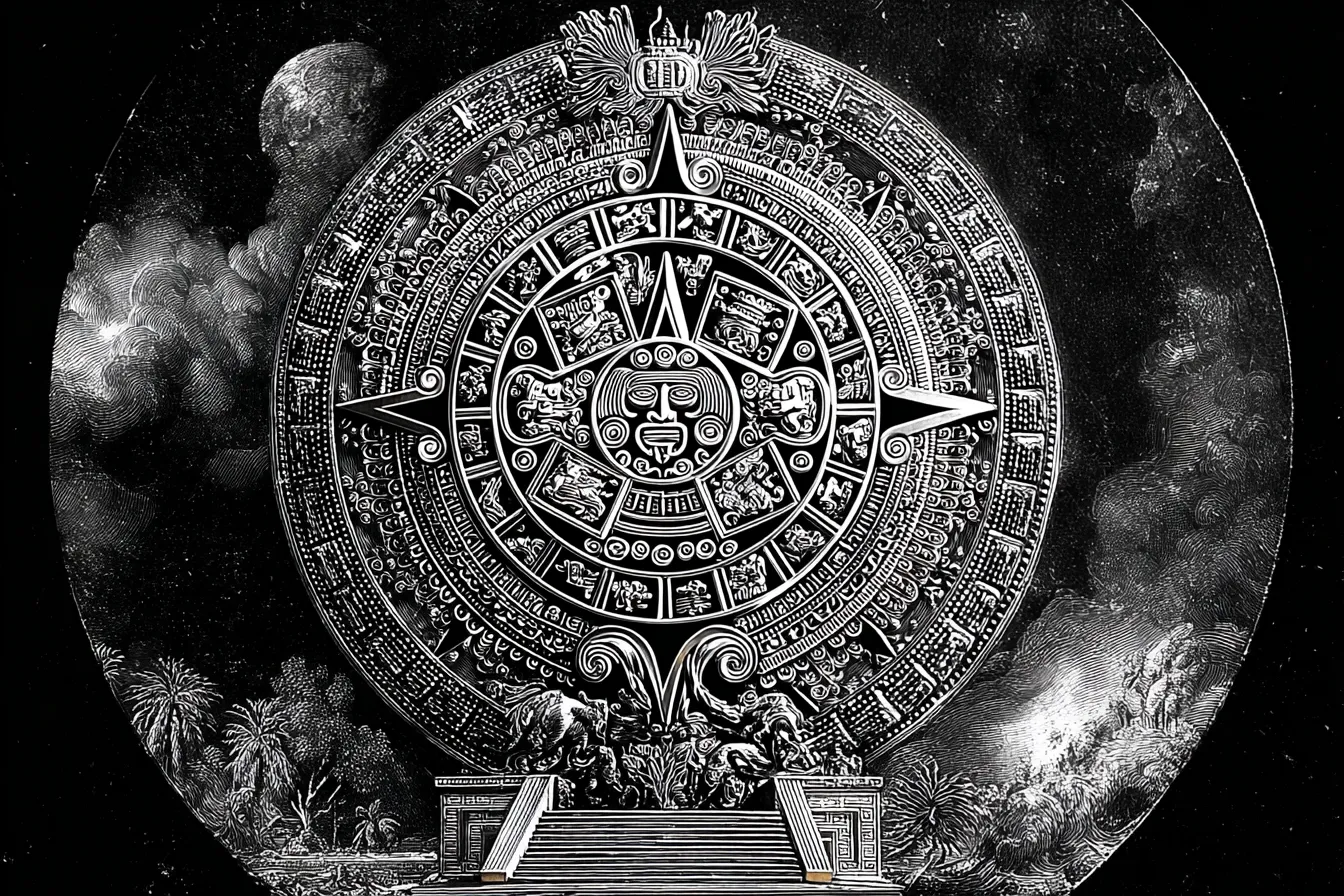
The eagle is the only creature, in the Aztec tradition, that can look directly at the sun. Not because it is immune to the sun’s intensity — but because it has eyes designed for exactly that confrontation. To see what most creatures cannot see, at a scale and altitude that makes the ordinary landscape entirely legible, you have to be capable of bearing what lesser sight cannot bear. The eagle doesn’t look away.
Cuauhtli — the Eagle — is the fifteenth day sign of the Aztec Tonalpohualli, and it occupies a position of particular solar significance. The Aztec warrior elite was divided into two orders: the jaguar warriors of the night and the earth, and the eagle warriors of the sun and the sky. Both were sacred. Both were expressions of the same martial devotion, applied to different aspects of the cosmos. Where the jaguar moves in darkness with instinct, the eagle moves in full light with vision. Where Ocelotl sees what is hidden, Cuauhtli sees what is exposed — everything, from above, at once.
Its patron is Xipe Totec — Our Lord the Flayed One — the god of agricultural renewal, of seasonal change, of the new skin that emerges after the old has been shed. Xipe Totec is depicted wearing the flayed skin of a sacrificial victim: the new over the old, the renewed self emerging from the covering of what has been given away. It is one of the most challenging images in the Aztec tradition. It is also one of the most specifically honest about what renewal actually costs.
What Is the Tonalpohualli?
The Tonalpohualli is the Aztec 260-day sacred calendar — 20 day signs combined with 13 tones in a cycle of 260 unique combinations. Your birth day sign was set by the position of this cycle on the day you were born and describes a fundamental quality of your energy. For the complete system, the Aztec Calendar overview covers how it works and how to find your sign.
How to Find Your Birth Day Sign
Your Tonalpohualli birth day sign requires converting your Gregorian birth date to a position in the 260-day cycle — a calculation that produces both your Day Sign and your Tone (1–13). The Whisper handles this automatically. For manual calculation, a Tonalpohualli correlation table aligned with established research gives the position.
Cuauhtli: The Core Energy
Xipe Totec’s mythology centers on an act of extraordinary creative sacrifice. To bring agricultural renewal — the new crop that requires the death of the previous season’s growth — a priest would wear the flayed skin of a sacrificial person for twenty days, representing the seed buried in the earth, gestating in the old covering, before emerging renewed. The image is disturbing. The meaning is precise: renewal is not the addition of something new over the old. It’s the emergence of the new from within the old, which has to be shed completely for the process to complete.
The direction is West — completion, integration, the deep knowing that comes from having traveled the full arc. West is the direction of the setting sun — not the end of light, but the sun in the phase of having given everything and descending into the rest that precedes the next rising. West gives Cuauhtli a quality of earned perspective: the view from the far end of the arc, where you can see the whole shape of what has passed.
The element is Fire — the sun’s element, the eagle warrior’s element, the purifying heat that burns away what is not essential. Cuauhtli’s Fire is the noon sun at its most direct: not the warming Fire of morning, not the transformative Fire of a forge, but the full intensity of the sun when it is overhead and there is no shadow.
The eagle’s specific qualities matter throughout. Eagles are thermally soaring birds — they ride the rising columns of heated air that the sun creates, climbing to altitudes where the entire landscape becomes visible simultaneously. This is not a metaphor for abstract thinking; it’s a precise description of a specific kind of intelligence. The eagle’s view is real data, gathered at altitude, that makes relationships between elements visible that cannot be seen from ground level. Cuauhtli people tend to carry this: the capacity for the overview perspective that can see the shape of a situation entire.
Traits of the Cuauhtli Birth Sign
The high view. Cuauhtli people tend to perceive situations from an elevated perspective — not detached or removed, but elevated enough to see the relationships between parts that ground-level participants cannot perceive simultaneously. This gives them an unusual capacity for strategic clarity, for seeing the whole shape of a situation while others are still navigating the interior.
Solar directness. The eagle looks at the sun. Cuauhtli people tend to look directly at what is true — including what is uncomfortably bright, what other people shade their eyes from, what requires the eagle’s specific optical capacity to see without damage. This directness is rarely harsh; it comes from genuine seeing rather than aggression.
The capacity for renewal through shedding. Xipe Totec’s renewal requires that the old covering come off. Cuauhtli people often have an unusual relationship to the ending of phases — they can complete what has been, shed what is no longer serving, and emerge into a genuinely new configuration with a willingness and thoroughness that other signs find difficult. They’ve often been through this process at least once in ways that were visible to others.
Eagle warrior focus. The Aztec eagle warriors were the elite of the elite — chosen not only for physical capability but for the quality of their devotion and their capacity to maintain focused intent. Cuauhtli people tend to have this quality of sustained, disciplined focus: once committed to a direction, they maintain the line with a consistency that comes from genuine conviction rather than stubbornness.
Thermal intelligence — rising on what the sun creates. The eagle doesn’t flap continuously; it finds the thermal columns and rides them upward. Cuauhtli people often have an intuitive read on the rising energies in a situation — on what is expanding, what is building momentum, what will lift rather than require constant effort. They tend to position themselves well relative to the forces in play.
The flayed skin’s honesty. Xipe Totec wears the truth of what renewal costs. Cuauhtli people tend to be unusually honest about the genuine cost of growth, change, and commitment — not pessimistically, but accurately. They don’t sell easy transformation. They describe what the shedding actually requires and then demonstrate that it’s worth it.
Challenges and Shadow Side
The altitude’s isolation. The eagle circles high and alone. Cuauhtli people can find genuine peer-level intimacy — the kind of closeness that requires being on the same terrain as another person, not looking down at them from above — genuinely difficult to sustain. The elevated perspective that is their greatest asset in many contexts creates a functional distance in the contexts that require being down on the ground together.
Xipe Totec’s demand for shedding applied prematurely. The renewal that requires the old skin to come off is real and necessary — but not everything that feels old needs to be shed immediately. Cuauhtli’s relationship to the shedding process can sometimes be applied to phases, relationships, or commitments that haven’t actually finished their work yet. The skin that comes off before the new one is ready leaves the vulnerable tissue exposed.
The full intensity of noon sun as social difficulty. The eagle’s solar directness is genuinely clarifying. It can also be too much — the full intensity of undimmed noon sun in a situation that needed softer light. Cuauhtli people sometimes need to develop the capacity to modulate the intensity of their presence, to bring partial rather than total solar clarity to situations where complete exposure would damage rather than illuminate.
The warrior’s orientation toward the heroic. Eagle warriors were defined by their devotion to an elevated ideal. Cuauhtli people can sometimes have a quality of orienting toward the heroic scale — the significant challenge, the meaningful sacrifice, the worthy opponent — that makes the ordinary, non-heroic dimensions of daily life feel insufficient. Not every moment can be the eagle in the sun. The thermal columns are not always available.
Renewal as a pattern rather than a process. Xipe Totec’s shedding is powerful when it’s genuine completion. When it becomes a pattern of continuous shedding — always in process, never arriving at the new configuration before the next shedding begins — it’s no longer renewal. It’s avoidance of the sustained inhabitation of any particular form.
Cuauhtli in Relationships and Vocation
In relationships, Cuauhtli brings a quality of genuine vision, directness, and the willingness to see and be seen that is unusual and valuable. The eagle doesn’t look away. When an Cuauhtli person is committed to a relationship, they bring the same focused intent and overhead clarity that they bring to everything they commit to. The relationship tends to be honest in ways that are occasionally uncomfortable and ultimately deepening.
The challenge is altitude and the ground-level requirements of sustained intimacy. Long-term closeness requires being present at the ordinary altitude of daily life — the repetition, the logistics, the phases that are not elevated or clarifying or renewal-shaped. The eagle that is always circling, always maintaining the overview perspective, is not available for the specific kind of presence that happens only at ground level. Learning to land — to spend extended periods at the altitude of ordinary life without translating everything immediately into the aerial view — is often significant developmental work for Cuauhtli.
In relationships with a Jaguar (Ocelotl), there is often a natural complementarity: the eagle’s solar vision and the jaguar’s night intelligence together cover the full spectrum. In relationships with other Fire signs, the shared directness can produce extraordinary clarity and can also produce a quality of intensity that burns rather than warms if both parties are operating at full solar force simultaneously.
In vocation, Cuauhtli tends toward work that requires and rewards the elevated perspective and the capacity for sustained, focused commitment: military and strategic leadership, executive roles that require seeing the entire organizational landscape, aviation and aerospace (the literal eagle), investigative work that requires patience and the long view, athletics and martial arts at the competitive level, any creative or intellectual work that requires the sun’s direct clarity sustained over time. The Xipe Totec quality appears in agricultural and ecological work, in medicine focused on genuine renewal, and in any role that involves guiding people through the shedding of what is no longer serving them.
The Tone (1–13): How Your Birth Number Modifies Cuauhtli
Your Tone — the number from 1 to 13 in your full Tonalpohualli birth position — modifies how Cuauhtli’s solar eagle energy expresses. Tone 1 Cuauhtli is the most concentrated and direct expression: the eagle at full solar intensity, the Xipe Totec renewal at its most thorough and demanding. Higher Tones bring progressive integration: a Tone 8 or 9 Cuauhtli has developed more of the capacity to calibrate the intensity — to know when the full noon sun is called for and when a different quality of light serves better.
How The Whisper Uses Cuauhtli
In The Whisper’s daily synthesis, your Cuauhtli birth sign contributes West Fire and solar overview awareness to the reading. When multiple systems converge on themes of elevated perspective, strategic clarity, and the willingness to look directly at what is true — BaZi Fire pillars, Nine Star Ki in an active outward-facing configuration, Western Sun transits emphasizing solar energy — The Whisper reads that convergence against your Cuauhtli foundation as a day when the eagle’s view is most fully available.
The Xipe Totec dimension produces specific readings around renewal and shedding. When the I Ching hexagram for the day speaks to the completion of one phase and the emergence of the next — hexagram 49 (Revolution), hexagram 50 (The Cauldron), hexagram 24 (Return) — and other systems are simultaneously indicating completion and new beginning, The Whisper reads that convergence as a specific message for your Cuauhtli foundation: the question is not whether the renewal is coming, but whether the old covering is ready to be released.