
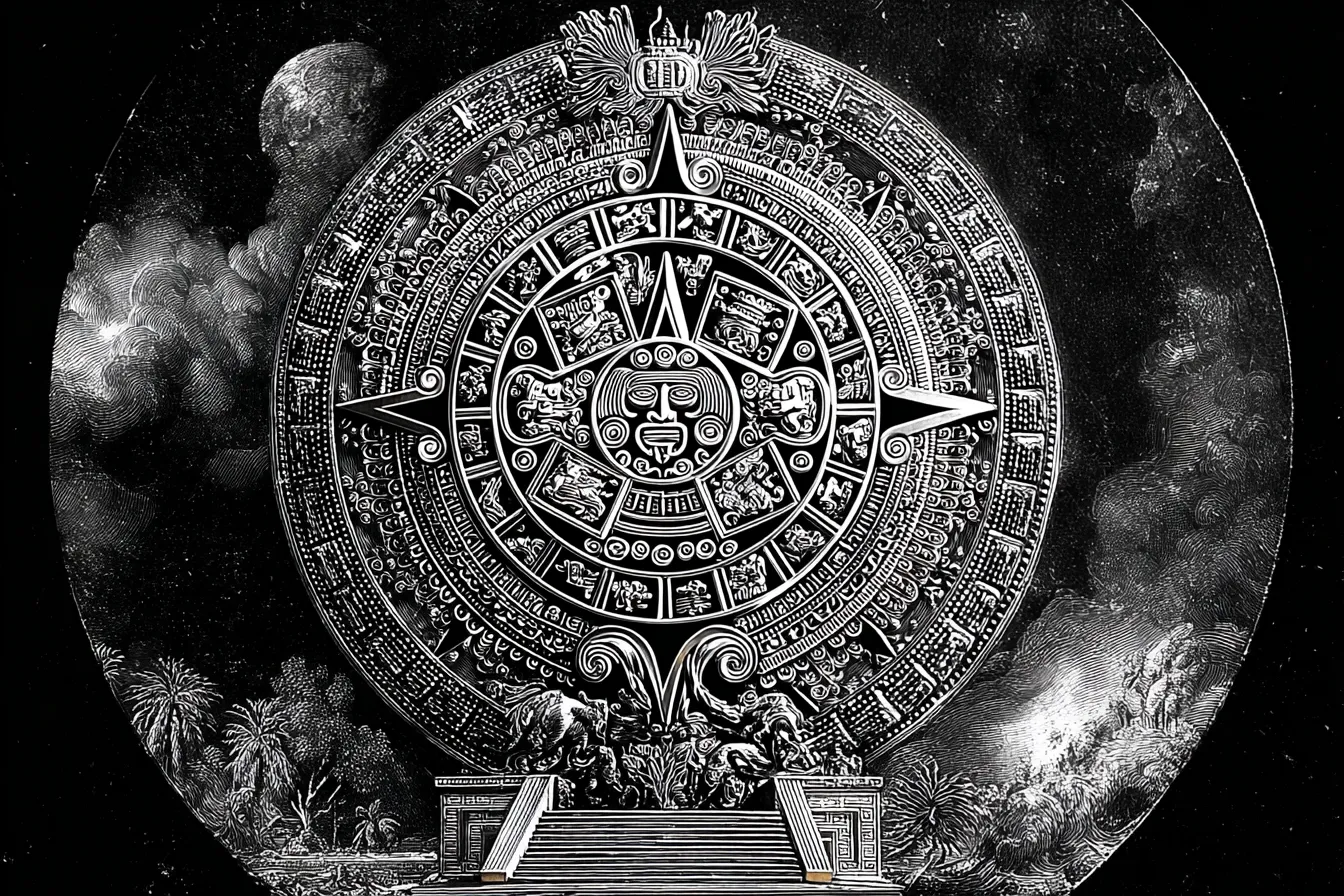
Wind doesn’t announce itself from a distance. It arrives, moves everything it touches, and is gone before you’ve fully registered it. You know Ehecatl by what it sets in motion — the turned page, the shifted conversation, the idea that was stuck until something moved through the room and suddenly it wasn’t.
The second day sign of the Tonalpohualli is Ehecatl, the Wind. Its patron is Quetzalcoatl in his aspect as the wind god — the Feathered Serpent who breathed life into the bones of previous humanity to create the people of the current age. Wind is not merely weather in the Aztec cosmological tradition. It is the breath of creation. It is what makes life possible and what disperses it. Those born under Ehecatl carry this at their core: the force that animates, the intelligence that moves through rather than staying, the presence that changes the air of wherever it passes.
What Is the Tonalpohualli?
The Tonalpohualli is the Aztec sacred calendar — 20 day signs combined with 13 numerical tones to create a 260-day cycle of distinct energetic signatures. Your birth day sign describes a fundamental quality of the energy you carry. For the full system explanation, the Aztec Calendar overview is the starting point.
How to Find Your Birth Day Sign
Your Ehecatl sign is calculated from your Gregorian birth date using a Tonalpohualli correlation that fixes your position in the 260-day cycle — producing both your Day Sign and your Tone (1–13). The Whisper handles this automatically when you enter your birth date.
Ehecatl: The Core Energy
Ehecatl’s patron is Quetzalcoatl — one of the most significant deities in the Aztec pantheon, associated with wind, the morning star Venus, knowledge, civilization, the arts, and the creation of humanity in the current age. The direction is North, associated in Aztec cosmology with the night wind, with testing, with the cold intelligence that strips away what is not essential. The element is Air.
Quetzalcoatl’s wind aspect is specific: he is Ehecatl-Quetzalcoatl, the wind that sweeps clean the paths so the rain gods can travel. Before the rains come, the wind comes first — preparing the way, clearing the old, creating the conditions for what comes next. Ehecatl people often function this way in their environments: they arrive, things shift, new possibilities open, and they may or may not be present for the aftermath.
The North direction adds a quality of penetrating clarity. The North wind doesn’t comfort — it clarifies. It cuts through the comfortable accumulated fog and shows things as they are. Ehecatl people often have this effect on groups and conversations: their presence tends to bring things into sharper focus, whether or not everyone finds the sharpness welcome.
Air as an element governs thought, communication, and the invisible connective tissue between things. Ehecatl is not just wind as weather — it’s wind as the medium of exchange between separate things. Ideas travel on Ehecatl energy. Connections form. The invisible becomes perceptible. This gives Ehecatl people an unusual aptitude for seeing relationships between apparently separate domains, for communicating complex ideas in forms that travel well, for inhabiting the in-between spaces where different worlds make contact.
The Quetzalcoatl dimension brings tremendous breadth. Quetzalcoatl is associated with civilization itself — with the gifts that make human life more than mere survival: writing, the calendar, corn cultivation, the arts, and the movement of Venus as the morning star that precedes the sun. Ehecatl people often carry a civilizing impulse: a drive to bring order, beauty, and transmitted knowledge into the environments they pass through.
Traits of the Ehecatl Birth Sign
Intellectual quickness and range. Ehecatl people process rapidly and across wide territory. They tend to be genuinely curious about many domains, to make connections between fields that specialists would consider unrelated, and to arrive at insights that feel like they came from somewhere other than ordinary sequential reasoning — because they did. The wind doesn’t travel in straight lines.
Gifts of communication and transmission. Quetzalcoatl is credited with giving humanity writing and the calendar. Ehecatl people are often unusually effective at transmitting ideas — making the complex accessible, finding the exact words for something others have been circling, bridging different audiences or communities through a capacity for tonal and contextual flexibility.
Catalytic social presence. Like the wind that sweeps clean the paths before rain, Ehecatl people tend to catalyze movement in social and intellectual environments. Things that were stuck loosen in their presence. Conversations that were circling find direction. This is not always intentional — it’s an effect of the energy.
Comfort with change and impermanence. Wind doesn’t stay. Ehecatl people tend to be constitutionally adapted to movement, change, and the ending of phases. Impermanence that distresses earth and water signs tends to feel, to Ehecatl, like simply the nature of things.
Perceptive reading of environments. The wind feels everything it moves through. Ehecatl people often have an acute sensitivity to the quality of environments — the temperature of a room, the unspoken dynamics of a group, the subtle shifts in a relationship before they become visible. This is not the deep empathic attunement of a Water sign; it’s a more detached, meteorological perception.
Challenges and Shadow Side
Rootlessness and difficulty sustaining. Wind doesn’t build; it moves things. Ehecatl’s shadow is the person who is always passing through — who catalyzes and departs, who begins and doesn’t finish, who forms connections and then releases them before they deepen into something structural. The North direction’s testing quality often arrives in the form of situations that demand sustained presence rather than catalytic passage.
Detachment mistaken for depth. Ehecatl’s clear perception can look like wisdom from the outside and feel like wisdom from the inside. But the wind sees everything without being changed by anything. Genuine depth requires being affected — allowing what you encounter to alter you, not merely pass through you. Ehecatl people sometimes need to learn the difference between the clarity of non-attachment and the detachment that protects against genuine encounter.
Difficulty being known. Wind is not containable. Ehecatl people are often experienced by others as somehow always slightly out of reach — present and perceptive and genuinely engaged, and also not fully there. This can be isolating in ways that are hard to trace, because the Ehecatl person’s experience of their own presence may not match others’ experience of their elusiveness.
The North wind’s edge. The clarifying quality that makes Ehecatl people valuable in conversations and communities can become a kind of sharpness that lands poorly. The North direction strips away comfort. Not every conversation needs to be stripped of its comfortable fog, and Ehecatl people sometimes need to develop the discernment for when the penetrating clarity is helpful and when it simply cuts.
Scattered across too many currents. Air moves in all directions simultaneously. Ehecatl people can find themselves drawn into too many conversations, projects, and ideas at once — each genuinely interesting, none receiving the sustained engagement that would allow it to deepen.
Ehecatl in Relationships and Vocation
In relationships, Ehecatl brings a quality of mental aliveness that others often find deeply stimulating. To be with an Ehecatl person is to be in an environment where ideas travel, where conversation has velocity, where you’re regularly surprised by the connection you didn’t see coming. They are often unusually good at creating the conditions for others to think more clearly — the Quetzalcoatl quality of clearing the path.
The challenge is the wind’s departure. Partners of Ehecatl people sometimes describe the experience as electrifying and also unsettling — a chronic mild uncertainty about whether the energy will still be there tomorrow, whether this particular wind is passing through or genuinely staying. Learning to make a genuine home — not a permanent location, but a genuine relational rootedness — is often significant developmental work for Ehecatl.
In vocation, Ehecatl tends toward work that requires communication, transmission, and the movement of ideas: writing, teaching, journalism, strategy and consulting, design in the conceptual sense, diplomatic and bridging roles, any work that requires moving between different worlds or communities. Ehecatl often thrives in the early phase of projects where fresh thinking and catalytic energy are the primary assets, and tends to find the long maintenance phases of established systems quietly suffocating.
The Tone (1–13): How Your Birth Number Modifies Ehecatl
Your full Tonalpohualli position includes both Ehecatl as your Day Sign and a Tone from 1 to 13. Tone 1 Ehecatl is the most concentrated and elemental expression of the wind quality — pure, undiluted, and potentially most challenging to ground. Higher Tones bring progressively more integration of the sign’s energy: a Tone 9 or 10 Ehecatl has developed some of the sustained presence that the pure wind quality lacks.
How The Whisper Uses Ehecatl
In The Whisper’s synthesis, your Ehecatl birth sign contributes Air and North energy to the daily reading. When today’s Tonalpohualli day is also Ehecatl, the wind quality is amplified — a day that favors communication, catalytic action, the transmission of ideas, and the clearing of stuck situations.
In cross-system convergences, BaZi Metal element pillars share a quality of sharp clarity with Ehecatl’s North wind; on days when multiple systems converge on clarity, cutting through, or the movement of ideas, The Whisper reads that convergence as specific permission and timing for that quality of action. The Western Mercury transits add a layer of precision about the specific quality of communicative energy available — whether the wind is favorable for transmission or whether it’s more likely to scatter than to carry.