
There’s a quality of resilience that comes from the twisted rather than the straight. A straight rod, struck hard enough, breaks. But a twisted cord — made of individual strands wound together, each one partially yielding — is among the strongest structures available to human engineering. The twist is not a flaw in the material. The twist is what makes it rope rather than stick.
Malinalli — Twisted Grass — is the twelfth day sign of the Tonalpohualli. Its patron is Patecatl, the god of medicine, fermentation, and the healing properties of plants, particularly the roots and herbs used in traditional Aztec medicine. Patecatl is also one of the patrons of pulque — alongside Mayahuel — but his association is with the medicinal rather than the intoxicating aspect: the specific knowledge of which plants heal, in what combinations, at what doses. Those born under Malinalli carry this quality: the knowledge of what has twisted in a life and how that twisting produced something more useful than a straight line would have.
What Is the Tonalpohualli?
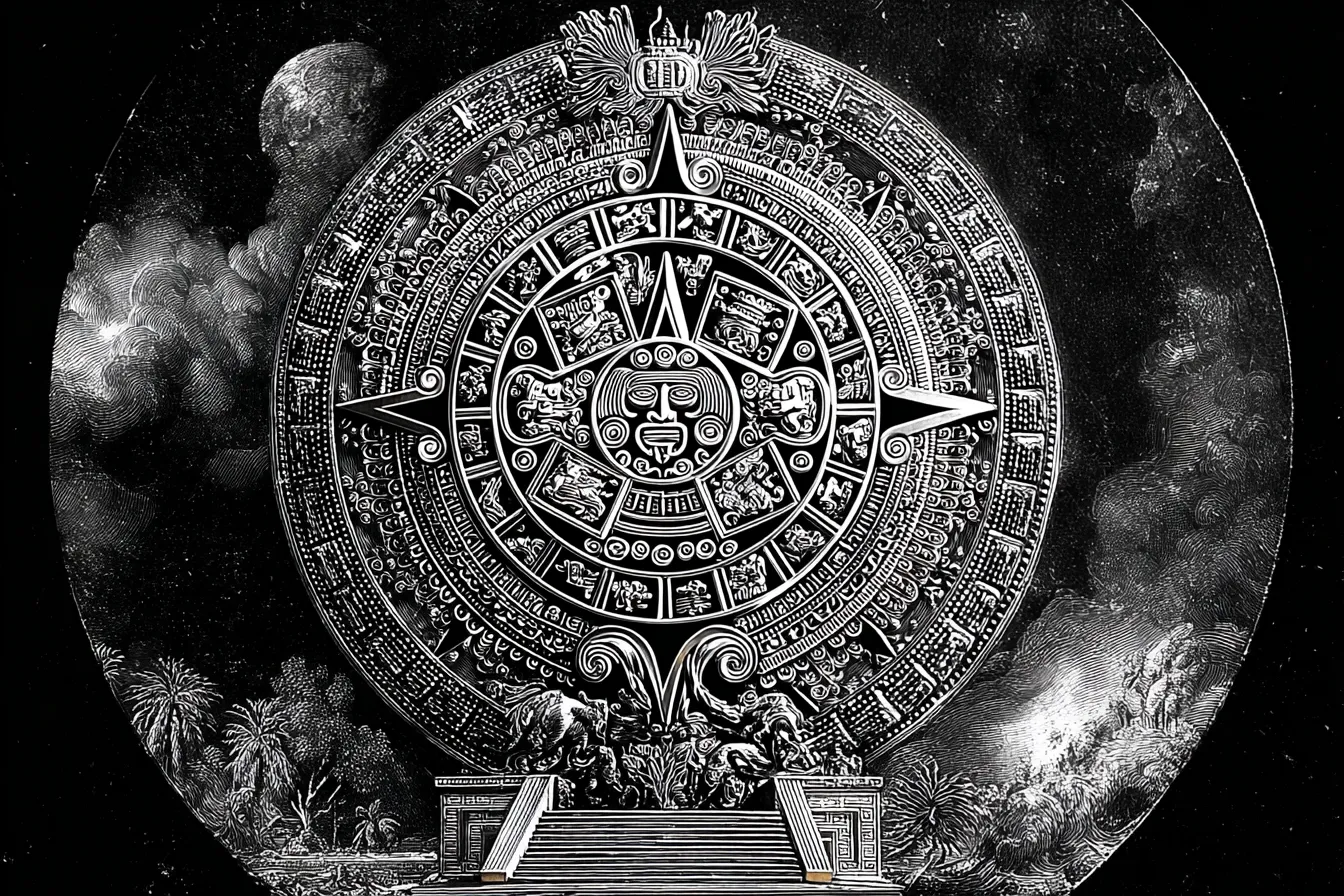
The Tonalpohualli is the Aztec 260-day sacred calendar, built from 20 day signs and 13 tones. Your birth day sign describes a foundational quality of your energy. For the full framework, the Aztec Calendar overview explains the complete system.
How to Find Your Birth Day Sign
Your Malinalli birth sign is located by correlating your Gregorian birth date with the 260-day Tonalpohualli cycle, a calculation that returns your Day Sign and Tone (1–13) together. The Whisper performs this automatically as soon as you enter your birth date.
Malinalli: The Core Energy
Patecatl’s domain is the knowledge of healing — specifically the accumulated wisdom of which substances, in what combinations, address which conditions. This is not intuitive healing but studied knowledge: the healer who knows the pharmacopoeia, who has learned which roots address fever and which herbs reduce inflammation and which combinations are dangerous. There is rigor in Patecatl’s care.
The direction is South — the noon sun, fertility, heat, the abundant generative force of life. South’s quality in Malinalli is the earth’s productive abundance: the field full of grass, the hillside covered in medicinal herbs, the landscape that looks like wilderness but is, to the knowledgeable eye, a pharmacy.
The element is Earth — specific, particular, the substance of the soil and what grows in it. Malinalli’s Earth is the earth of the medicine garden: tended, purposeful, full of things that heal when you know what they are.
The twisted grass itself is significant. Grass in the Mexican landscape is not a monoculture lawn — it’s a complex, multi-species matrix of plants that withstand drought by going brown, survive fire by regrowing from roots, and resist being pulled out because their root systems are extensive and interwoven. The twist in Malinalli’s name suggests something that has been worked — like twisting fibers into rope, like the braiding of medicinal herbs into ceremonial bundles, like the spiral of a DNA strand that contains the instructions for its own continuation.
Malinalli people tend to have been through things. Not necessarily dramatic trauma, though that’s sometimes the case — but a quality of having been tested, of having had the straightforward path twisted out from under them, of having learned to navigate by means that were more complex than they expected. This history is their resource. The twist is the medicine.
Traits of the Malinalli Birth Sign
Resilience through complexity. Malinalli people don’t break under pressure in the way that simpler structures break. They bend. They’ve been bent before and know how. This is not absence of feeling — they feel things deeply — but the twisted quality means the force distributes rather than concentrating in a breaking point.
The healer’s knowledge from experience. Patecatl’s medicine comes from study, but Malinalli’s medicine comes from having been through the condition. They tend to have a quality of knowledge about difficulty — what it actually feels like, what actually helps — that derives from personal acquaintance rather than theoretical understanding.
Tenacity. Grass doesn’t give up. It goes brown in drought and comes back when the rain arrives. Malinalli people often have an unusual quality of long-term tenacity — not the dramatic endurance of a battle but the quiet persistence of something with deep roots that simply doesn’t stop.
Transforming what is difficult into resource. The twisted fiber becomes rope. Malinalli people tend to have a natural capacity for finding the use in what appeared to be damage — converting difficult experience into wisdom, converting wound into gift, finding the medicinal quality in the herb that others would have dismissed as a weed.
Complex, non-linear intelligence. The twist suggests non-linearity. Malinalli people tend to have an intelligence that doesn’t move in straight lines — that makes connections that seem strange until they’re revealed to be profound, that sees the medicinal combination in elements that appeared unrelated.
Challenges and Shadow Side
The wound that becomes an identity. The twisted grass is defined by its twist. Malinalli’s shadow is the person for whom the difficulty that produced the resilience has become so central to their identity that they cannot imagine themselves without it — who keeps returning to the wound, who relates to others primarily from the position of what they’ve survived rather than what they’re building. The medicine is made from the herb; you don’t carry the herb in your body forever.
Using complexity to avoid simplicity. The twisted intelligence that produces profound connections can also become a way of avoiding the straightforward — of making everything more complicated than it needs to be because straightforwardness feels dangerous or insufficient. Sometimes the grass just needs to be grass.
Accumulated heaviness. Everything that has been survived accumulates. Malinalli people sometimes carry a weight of processed difficulty that, over time, becomes its own burden — not because the processing didn’t work, but because the cumulative weight of having been through a lot is heavy regardless of what you’ve made of it.
Difficulty with ease. People who have earned their wisdom through difficulty sometimes find straightforward good fortune strange and untrustworthy. When things are easy, Malinalli people can find themselves waiting for the twist that will reveal the difficulty underneath. Learning to receive ease without suspicion is often significant work.
Malinalli in Relationships and Vocation
In relationships, Malinalli brings depth, genuine understanding, and a quality of resilience that partners find deeply reliable. They are not easily frightened off by difficulty — they’ve seen difficult before and know how to be with it. The relationship with a Malinalli person tends to have roots.
The challenge is the distance that can exist between the depth of their interior experience and the difficulty of sharing it. Malinalli people often know what they’ve been through, have made something of it, and carry it in a way that’s simultaneously present and private. Partners sometimes describe the experience of loving a Malinalli person as knowing them by what they can bear and not always knowing what it costs.
In vocation, Malinalli tends toward the healing arts in their broadest sense: medicine with a particular aptitude for complex cases, psychology and counseling, herbalism and plant medicine, social work, restorative justice, and any role that requires working with what has been damaged and finding the path toward function. The twisted-grass quality also appears in legal and advocacy work — finding the argument that conventional approaches missed, the root system that supports the case.
The Tone (1–13): How Your Birth Number Modifies Malinalli
Tone 1 Malinalli carries the most concentrated expression of the twisted-grass resilience — the deepest roots and the most significant accumulation of converted difficulty. Higher Tones tend to bring more lightness alongside the depth: a Tone 12 Malinalli has often developed the capacity to hold the wisdom without always leading with the wound.
How The Whisper Uses Malinalli
In The Whisper’s synthesis, your Malinalli birth sign contributes South Earth and healing-through-complexity awareness to the daily reading. When multiple systems converge on themes of resilience, the conversion of difficulty into resource, or the specific knowledge that comes from having endured, The Whisper reads that convergence against your Malinalli foundation as meaningful information about what the current moment’s specific texture of difficulty is offering — and what medicine might be made of it.