
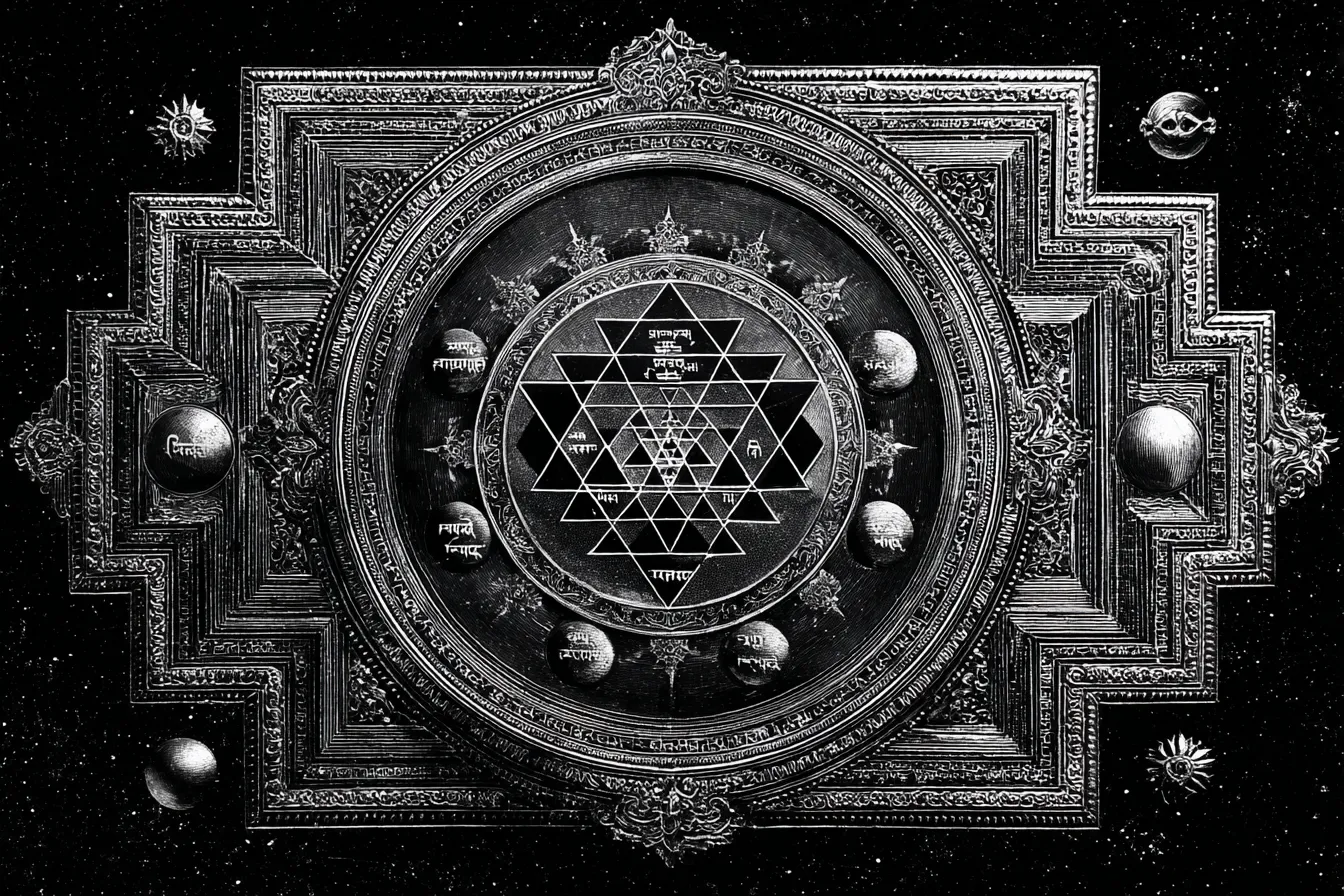
What is Vedic astrology?
Jyotiṣa (ज्योतिष) — rendered in English as Vedic astrology or Hindu astrology — is one of the six Vedāṅgas, the auxiliary disciplines of the Vedas, the foundational texts of the Indian philosophical tradition. Its documented history stretches from the Vedāṅga Jyotiṣa (approximately 1200–1000 BCE) through the classical period of the Bṛhat Parāśara Horā Śāstra, Varāhamihira’s Bṛhat Jātaka (6th century CE), and a continuous stream of commentary and practice that extends without interruption to the present day. Jyotiṣa is not a reconstructed or recently revived system; it is a living tradition actively practised across South Asia and in diaspora communities globally.
The word jyotiṣa derives from jyotis — light, luminosity — which captures the tradition’s self-understanding: it is a system for reading the quality of time, for perceiving the light of any given moment and understanding what that light illuminates about the present conditions of a life.
How Vedic astrology differs from Western astrology
The most immediate difference between Vedic and Western astrology — and the one that most surprises people encountering Jyotiṣa for the first time — is the zodiac itself.
Western astrology uses the tropical zodiac, anchored to the seasons: Aries begins at the spring equinox, Taurus follows, and so on around the year. Vedic astrology uses the sidereal zodiac, anchored to the actual positions of fixed stars. Because of the slow precession of the Earth’s axis — a cycle of approximately 26,000 years — the two zodiacs have drifted apart by roughly 23 degrees, which corresponds to about one month in calendar terms. The accumulated difference is called the ayanāṃśa.
The practical consequence is significant: if you know yourself as a Western Aries (Sun sign, late March to mid-April), your Vedic Sun sign is most likely Mīna (Pisces). If you are a Western Taurus, you are probably a Vedic Meṣa. The signs share names and some symbolic associations, but they do not occupy the same portion of the sky, and in some cases their interpretive emphases differ meaningfully.
The second major difference is which planetary placement matters most. Western astrology centres on the Sun sign as the primary character indicator. Jyotiṣa centres on the Moon sign (Chandra Lagna) — the sign the Moon occupied at birth. In the classical Jyotiṣa understanding, the Moon governs manas (the mind, the emotional-processing faculty), making it the most direct indicator of how a person actually experiences daily life from the inside. The Sun sign is used as a tertiary indicator; the Lagna (Ascendant — the sign rising on the eastern horizon at birth) is used as a secondary indicator when birth time is known.
Additional differences include the central importance of the Nakshatra system (27 lunar mansions that divide the zodiac into finer segments), the Dasha system (planetary period cycles that govern the timing of life events), and the Ashtakavarga strength-scoring system. These make Jyotiṣa a substantially different analytical framework from Western astrology, not merely a culturally distinct version of the same approach.
The 12 Rāśis: the signs of Vedic astrology
The twelve rāśis (राशि) of Jyotiṣa correspond to the same twelve zodiacal divisions as Western astrology, but — due to the sidereal-tropical difference — they occupy different portions of the solar year, and the classical tradition gives each sign a distinct set of associations rooted in Indian cosmology, the Five Elements, and the planetary rulerships of classical Jyotiṣa.
Each Rāśi is characterised by three factors: its element (tattva — Fire, Earth, Air, or Water), its modality (chara / moveable, sthira / fixed, or dvisvabhāva / dual-mutable), and its ruling planet (adhipati). These three factors combine to produce each sign’s distinct quality. Understanding them is foundational to reading a Jyotiṣa chart.
The twelve Rāśis, with their approximate sidereal solar dates, are:
Fire signs (Agni tattva): Meṣa (the Ram, ~April 14 – May 14), Siṃha (the Lion, ~August 17 – September 16), Dhanus (the Archer, ~December 16 – January 13). Fire signs share the qualities of initiating energy, vitality, and the directional force of genuine purpose — but each expresses these qualities through a different modality and ruling planet.
Earth signs (Pṛthvī tattva): Vṛṣabha (the Bull, ~May 15 – June 14), Kanyā (the Maiden, ~September 17 – October 16), Makara (the Crocodile, ~January 14 – February 12). Earth signs share the qualities of material intelligence, stability, and the capacity to produce results that hold — but again, each through its own distinct mode.
Air signs (Vāyu tattva): Mithuna (the Twins, ~June 15 – July 15), Tulā (the Scales, ~October 17 – November 15), Kumbha (the Water-Bearer, ~February 13 – March 13). Air signs share the qualities of communicating intelligence, relational sensitivity, and the capacity to move through and between things without being fixed by them.
Water signs (Jala tattva): Karkaṭa (the Crab, ~July 16 – August 16), Vṛścika (the Scorpion, ~November 16 – December 15), Mīna (the Fish, ~March 14 – April 13). Water signs share the qualities of feeling, depth, and the intelligence that perceives what lies beneath the surface of appearances.
The three modalities
Each Rāśi also belongs to one of three modalities that describe how its energy moves:
Chara (moveable) signs — Meṣa, Karkaṭa, Tulā, Makara — initiate and move. They are most fully themselves at the beginning of things, in the act of responsive, oriented movement toward what is genuinely needed.
Sthira (fixed) signs — Vṛṣabha, Siṃha, Vṛścika, Kumbha — sustain and concentrate. They hold their quality through all seasons, building the depth and stability that the chara signs initiate.
Dvisvabhāva (dual or mutable) signs — Mithuna, Kanyā, Dhanus, Mīna — adapt and synthesise. They hold two natures simultaneously, functioning as the threshold between one state and another, and are most fully themselves in the act of transition, integration, and the discovery of what connects apparently separate things.
Special planetary positions: exaltations and debilitations
Classical Jyotiṣa assigns each planet a sign in which it reaches its greatest strength (ucchastha, exaltation) and a sign in which its qualities are most constrained (nīchastha, debilitation). These placements are among the most significant in chart interpretation:
The Sun is exalted in Meṣa (in the Aśvinī Nakshatra) and debilitated in Tulā. The Moon is exalted in Vṛṣabha (in Rohiṇī Nakshatra) and debilitated in Vṛścika. Mars is exalted in Makara (in Śravaṇa Nakshatra) and debilitated in Karkaṭa. Mercury is exalted in Kanyā (in Hastā Nakshatra) and debilitated in Mīna. Jupiter is exalted in Karkaṭa (in Puṣya Nakshatra) and debilitated in Makara. Venus is exalted in Mīna (in Revatī Nakshatra) and debilitated in Kanyā. Saturn is exalted in Tulā and debilitated in Meṣa.
These exaltation and debilitation positions carry significant interpretive weight in a full Jyotiṣa reading — they indicate where each planet’s qualities find their most or least complete expression.
The Nakshatras: the lunar mansions
One of the most distinctive features of classical Jyotiṣa, with no exact parallel in Western astrology, is the system of 27 Nakshatras (नक्षत्र) — the lunar mansions. The Nakshatras divide the sidereal zodiac into 27 segments of approximately 13 degrees and 20 minutes each, corresponding to the Moon’s daily movement through the sky.
Each Nakshatra carries its own name, ruling planet, presiding deity, and symbolic quality. The Nakshatra the Moon occupied at birth — the Janma Nakshatra or birth Nakshatra — is one of the most important single placements in a Jyotiṣa chart, providing a finer-grained reading of the Moon sign’s character than the sign alone can offer.
Each of the twelve Rāśis contains either two or three Nakshatras, and the Nakshatra placement within a sign often modifies the sign’s quality significantly. Meṣa, for example, contains Aśvinī (speed, healing), Bharaṇī (threshold-crossing), and the first pada of Kṛttikā (sharp, solar fire) — three quite different qualities within the same sign. Understanding which Nakshatra a natal planet occupies deepens the reading considerably.
The Dasha system: timing in Jyotiṣa
The Dasha system is one of the most significant features of Jyotiṣa and one of the clearest markers of its difference from Western astrology. A Dasha is a planetary period — a span of years governed by a particular planet, during which that planet’s qualities become particularly active in the person’s life. The most widely used system, the Viṃśottarī Dasha, assigns 120 years total across the seven classical planets and two nodes (Rahu and Ketu), with each planet governing a set period ranging from 6 years (Sun) to 20 years (Venus).
The Dasha in operation at any given time provides the primary timing context for interpreting current life experience in Jyotiṣa. The same natal chart reads very differently during a Jupiter Dasha than during a Saturn Dasha — the qualities of the governing planet are amplified and made more central to the person’s experience during its period.
The Whisper does not calculate full Dasha periods — this requires a complete Jyotiṣa analysis by a qualified practitioner. What The Whisper uses are the natal Rāśi quality (primarily Moon sign, secondarily Lagna), the current planetary transits (gocharas), and the active Nakshatra of the day.
How The Whisper uses Vedic astrology
In The Whisper’s synthesis, Vedic astrology contributes two layers to your daily reading:
The natal layer — your birth Rāśi (primarily Moon sign, secondarily Lagna) provides the stable character quality that does not change from day to day. This is the lens through which all other information in the reading is filtered. Each of the twelve Rāśis carries a distinct quality, and understanding yours is the foundation of how The Whisper reads your Vedic astrology.
The dynamic layer — the current planetary transits (gocharas) and the Nakshatra the Moon is transiting today provide the dynamic, day-specific quality that shifts the stable natal character into contact with the particular energies of this moment. A person with a Meṣa Moon will have a different reading on a day when the Moon is transiting Puṣya (the most nourishing Nakshatra) than on a day when it is transiting Ārdrā (the storm-clearing Nakshatra).
Both layers are then synthesised with BaZi, Nine Star Ki, Western Astrology, and up to twelve other active systems into a single daily insight — the integrated reading that is The Whisper’s core offering.
Explore the 12 Rāśis
Each of the twelve Rāśis has its own article with a complete exploration of its classical roots, elemental and modal quality, Nakshatra composition, and what it means in The Whisper’s daily synthesis. Begin with your Moon sign — which you can find using a Jyotiṣa calculator with your birth date, time, and location — or explore from the beginning of the zodiacal cycle:
Fire Rāśis: Meṣa — The Ram · Siṃha — The Lion · Dhanus — The Archer
Earth Rāśis: Vṛṣabha — The Bull · Kanyā — The Maiden · Makara — The Crocodile
Air Rāśis: Mithuna — The Twins · Tulā — The Scales · Kumbha — The Water-Bearer
Water Rāśis: Karkaṭa — The Crab · Vṛścika — The Scorpion · Mīna — The Fish
Frequently asked questions
Q: How do I find my Vedic Moon sign?
To find your Vedic Moon sign, you need your birth date, birth time, and birth location — and a Jyotiṣa calculator that uses the sidereal zodiac. The birth time matters because the Moon moves through a new sign roughly every 2.5 days; without an accurate birth time, the Moon sign calculation may be incorrect if you were born near a sign boundary. Many free online Jyotiṣa calculators will give you your Moon sign, Lagna, and natal Nakshatra. The Whisper calculates your Vedic inputs from your birth data directly.
Q: Is Vedic astrology more accurate than Western astrology?
This framing of “more accurate” misunderstands what both systems are doing. Vedic astrology and Western astrology are different systems with different philosophical foundations, different zodiacs, and different areas of emphasis — not competing attempts to do the same thing. Jyotiṣa emphasises the Moon, the Lagna, the Nakshatras, and the Dasha timing system; Western astrology emphasises the Sun, the outer planets, and the psychological dimensions of the planetary archetypes. They reveal different dimensions of experience. The Whisper uses both precisely because they are genuinely complementary rather than redundant.
Q: What is the difference between Jyotiṣa and popular “Vedic astrology” content online?
Classical Jyotiṣa — as found in the textual tradition including the Bṛhat Parāśara Horā Śāstra and the works of Varāhamihira — is a technically complex system requiring years of study to practice with genuine depth. Much of the “Vedic astrology” content online is simplified, sometimes significantly, or blends classical Jyotiṣa with Western astrological concepts in ways that classical practitioners would not recognise. The Whisper draws on the classical tradition’s understanding of the Rāśis, Nakshatras, and planetary qualities, while being honest about the scope of what a daily synthesis tool can and cannot provide — and about where a qualified Jyotiṣa practitioner’s analysis goes far beyond what any application can offer.