
There’s a kind of seriousness that masquerades as maturity but is actually just heaviness — a refusal to allow for the kind of play that makes everything else bearable and, often, possible. And then there is the actual work of keeping joy alive in a world that tends to crowd it out: the artist who insists on making something beautiful when making something useful would have been easier, the musician who finds the exact note that opens the room, the person who always knows the right moment for the joke that converts tension into genuine laughter.
Ozomatli — the Monkey — is the eleventh day sign of the Tonalpohualli, and its patron is Xochipilli: the Prince of Flowers, the god of arts, music, dance, poetry, games, beauty, and the specific kind of sacred intoxication that comes from genuine creative expression. Xochipilli is not a minor deity in the Aztec tradition. He is the patron of the sun’s joyful aspect, of the morning star, of the creative force that makes life worth living. Those born under Ozomatli are under his care — which means they carry a calling, not just a personality trait.
What Is the Tonalpohualli?
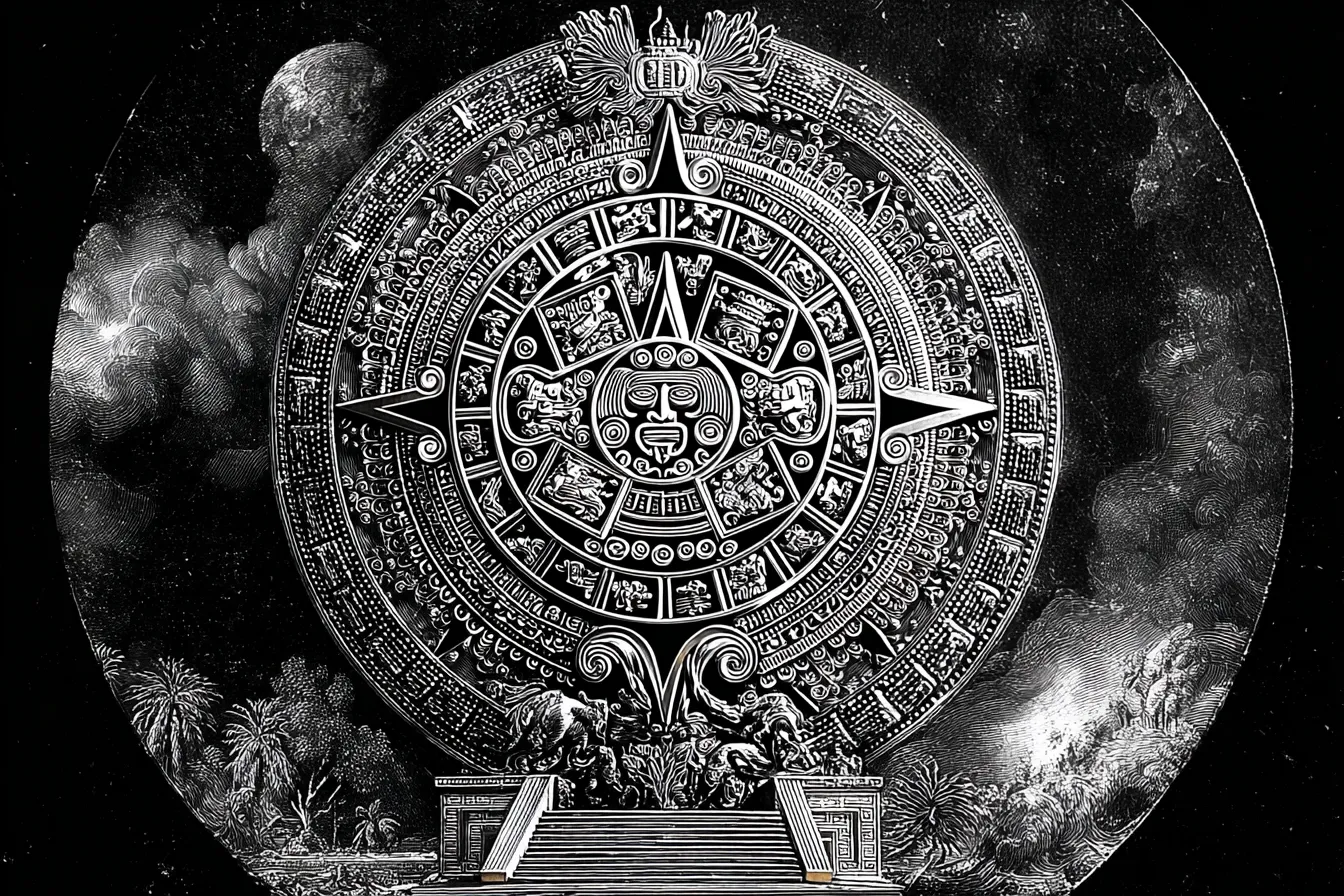
The Tonalpohualli is the Aztec 260-day sacred calendar — 20 day signs combined with 13 tones in a cycle where each combination occurs exactly once. Your birth day sign describes a foundational quality of your energy. For the complete system, the Aztec Calendar overview covers how it works.
How to Find Your Birth Day Sign
Your Tonalpohualli day sign is read from a correlation between your Gregorian birth date and the 260-day cycle, not from arithmetic on the date — the result includes both your Day Sign and your Tone (1–13). The Whisper calculates it automatically when you enter your birth date.
Ozomatli: The Core Energy
Xochipilli — Prince of Flowers — governs the arts not as mere decoration but as the sacred human activity of expressing what exceeds ordinary language. In the Aztec tradition, the arts were a form of prayer, a way of touching the divine through the precision of a rhythm, the exact color of a dye, the perfect word in a poem that makes something real that wasn’t real before. Xochipilli’s domain includes music, dance, painting, poetry, and games — specifically the ball game, which was sacred in Mesoamerica and connected to astronomical and cosmological cycles.
The direction is West — completion, integration, the deep knowing of the full arc. West is where the sun goes when it’s done — not ended, but resting in the fullness of what has been. It gives Ozomatli a quality of wisdom-through-experience rather than wisdom-through-abstraction: the monkey who has swung through the whole canopy and knows where all the fruit is.
The element is Air — the medium of music, of breath, of the space between notes that is as important as the notes themselves. Air governs communication and the transmission of invisible things. Ozomatli’s Air is not the intellectual Air of Ehecatl or the cutting Air of Miquiztli — it’s the musical Air, the medium through which what the artist makes travels to the one who receives it.
The monkey itself contributes qualities that are worth examining directly. In Mesoamerican traditions, the monkey is associated with the artists and craftspeople of a previous age — the second or third sun, depending on the source — whose world was destroyed but whose creative gifts survive in the arts of the current era. Monkey people carry this inheritance: the creativity that survived catastrophe, the play that persists despite everything, the art that continues because it must.
Traits of the Ozomatli Birth Sign
Genuine creative gift. Ozomatli people tend to have natural aptitude for one or more of the arts — music, visual art, writing, dance, performance, design. This isn’t just appreciation; it’s the capacity to make something that carries genuine creative force. The Xochipilli quality means this creativity is connected to something larger than personal expression.
Play as a serious practice. The monkey’s play is not trivial — it’s the primary mode of learning, relating, and creating. Ozomatli people often have a quality of playful engagement with everything they do, including the serious things. This is not an avoidance of seriousness; it’s a fundamentally different relationship to how things get accomplished.
Social intelligence and timing. Ozomatli is a social sign — the monkey is never alone for long. Ozomatli people tend to have excellent timing in social contexts: they know when the joke will land, when the story will open the room, when the music will change the atmosphere. This is a form of intelligence that operates through attunement rather than analysis.
Capacity for joy. This sounds simple and is actually rare. Ozomatli people can be genuinely happy in ways that don’t require specific external conditions. The Xochipilli quality is a relationship to joy as a natural state rather than an achievement. They tend to find more occasions for delight than most.
The ability to shift the room. Xochipilli’s gifts change the atmosphere. Ozomatli people can enter a group that is heavy, stuck, or tense and — without necessarily doing anything explicit — shift the quality of what’s happening. This is a creative and social gift of real significance.
Challenges and Shadow Side
Play as avoidance. The same capacity that makes Ozomatli joyful can become the thing that prevents genuine depth. Not every situation is improved by wit. Not every grief wants to be lightened before it’s been fully felt. Ozomatli’s shadow is the person who uses play, humor, and creative energy to skip the difficult interior work.
Scattered attention across too many creative directions. Xochipilli’s domain is wide. Ozomatli people can find themselves genuinely gifted in multiple creative domains simultaneously and unable to focus enough on any one of them to develop the depth that mastery requires. The monkey swings through everything and doesn’t stay anywhere long enough.
Dependence on social energy. Ozomatli thrives in the social. In isolation, the creative energy can become restless, the play can curdle, and the joy that comes easily in good company can be genuinely hard to access alone. Building a relationship to the interior creative practice — the work that doesn’t require an audience — is often important development for Ozomatli.
The previous age’s creative gifts. The monkey as the artist of a destroyed world carries something elegiac alongside the joy — a quality of making beauty in the face of impermanence, of creating something that will not last. This can be a deep and genuine artistic orientation, or it can become a reason never to invest fully in anything.
Ozomatli in Relationships and Vocation
In relationships, Ozomatli brings genuine delight, playfulness, and creative vitality. To be with an Ozomatli person in a good period is to live in a more colorful world — they bring art, laughter, unexpected beauty, and the quality of engagement that makes ordinary life feel genuinely alive. They are often the people who make the relationship’s joy, not just maintain its function.
The challenge is depth in the difficult phases. When the relationship moves through its harder terrain — conflict, loss, the phases that require sustained presence with what is uncomfortable rather than creative transformation of it — the Ozomatli quality can struggle. Staying with what is heavy without immediately lightening it is often the developmental work.
In vocation, Ozomatli’s territory is the creative arts and wherever creative energy is the primary asset: music, visual art, writing, performance, design, animation, game design, teaching in ways that require genuine creative presence. The social intelligence dimension also appears in facilitation, community organizing, and roles that require changing the atmosphere of groups. Ozomatli tends to find work that requires sustained repetition without creative latitude genuinely suffocating over time.
The Tone (1–13): How Your Birth Number Modifies Ozomatli
Tone 1 Ozomatli is the most elemental expression of the monkey-artist quality — the most joyful, the most creative, and the most susceptible to the shadow of scattered attention and depth-avoidance through play. Higher Tones bring more integration: a Tone 11 Ozomatli (appropriately — the sign’s own number) has often developed the specific combination of creative breadth and focused depth that Xochipilli’s gifts require to reach their fullest expression.
How The Whisper Uses Ozomatli
In The Whisper’s synthesis, your Ozomatli birth sign contributes West Air and creative-social intelligence to the daily reading. When multiple systems converge on themes of creative expression, joy, or the movement of Air through social connection, The Whisper reads that convergence as a specific amplification of your Ozomatli foundation — a day when the creative and playful gifts are most available, when making something, expressing something, or bringing more aliveness to the shared environment is most supported by the current moment.