
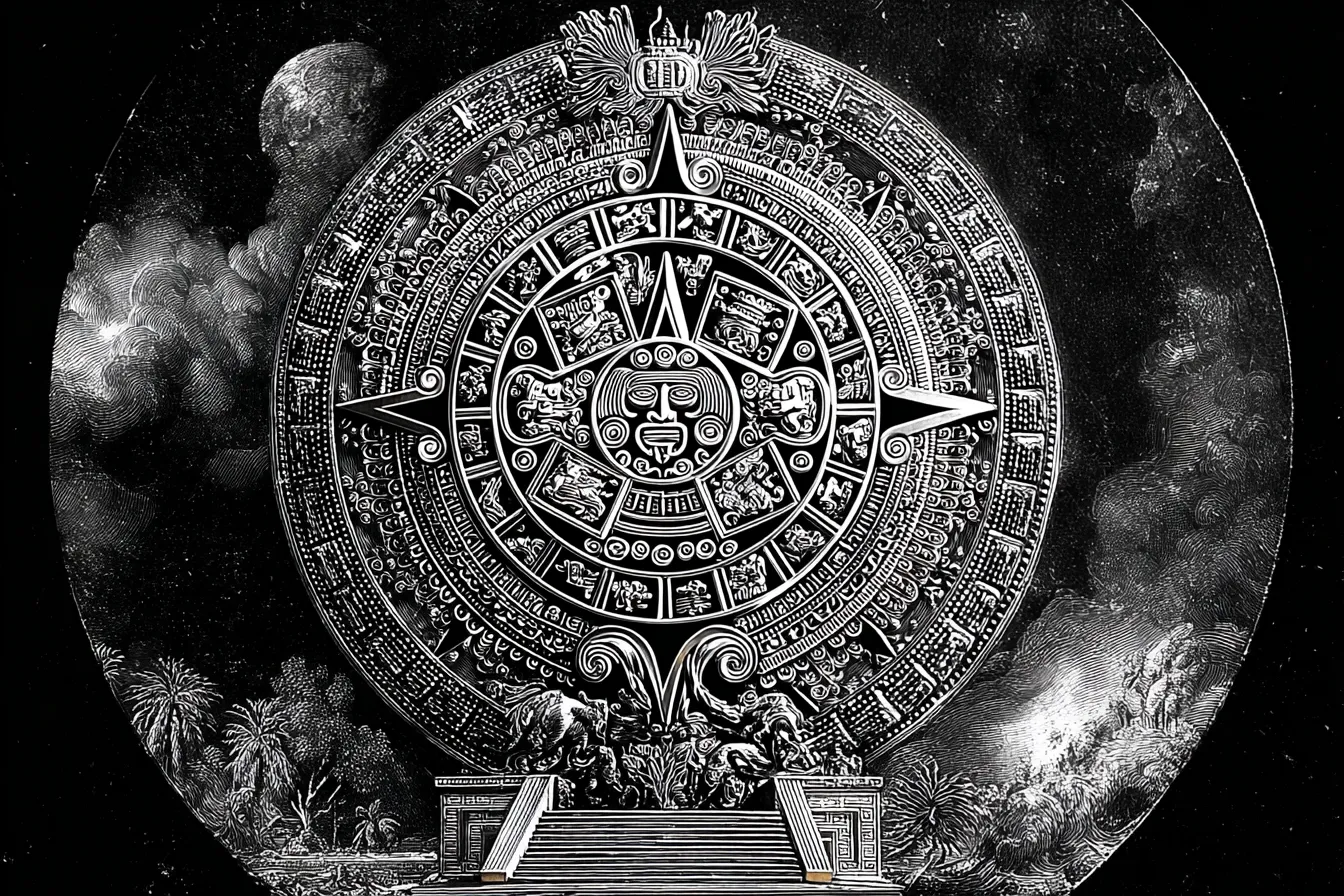
The rain falls because the sun has been working. The sun heats the ocean and the lakes and the rivers, evaporating water into the sky, building the clouds that eventually release their weight back to the earth as rain. Without the sun’s expenditure of heat, there is no rain. The rain is, in a precise physical sense, the sun giving itself away — converting its energy into the form that nourishes the land.
This is the paradox at the center of Quiauhtl, the nineteenth day sign of the Aztec Tonalpohualli. The sign means Rain, but its patron is Tonatiuh — the Sun God, the fifth sun, the current solar era’s divine embodiment, the deity who requires the blood of sacrifice to continue rising each morning because the act of rising costs everything he has. Tonatiuh is the god of total self-expenditure in service of the life that depends on him. Quiauhtl is the sign of what that self-expenditure produces when it reaches the earth: the rain that makes things grow.
Those born under Quiauhtl carry this paradox as a lived reality. They are nourishing in a way that has Fire at its source — a giving that comes not from gentle abundance but from genuine self-expenditure. The rain is generous. The rain also depletes the sun.
What Is the Tonalpohualli?
The Tonalpohualli is the Aztec 260-day sacred calendar — 20 day signs combined with 13 tones in a cycle of 260 unique combinations. Your birth day sign describes a foundational quality of the energy you carry. For the complete framework, the Aztec Calendar overview covers the full system and how to find your sign.
How to Find Your Birth Day Sign
The Tonalpohualli calculation converts your Gregorian birth date to a position in the 260-day cycle, producing both your Day Sign and your Tone (1–13). The Whisper handles this automatically when you enter your birth date.
Quiauhtl: The Core Energy
Tonatiuh — the fifth sun — was created at Teotihuacan, when the gods gathered in darkness to determine who would become the new sun. Nanahuatzin, poor and diseased, threw himself into the fire without hesitation and became the sun. Tecuciztecatl, proud and wealthy, hesitated four times before jumping and became only the moon. But even after creation, the sun wouldn’t move — it sat in the sky, waiting, until the other gods sacrificed themselves to give it the force to move. Tonatiuh requires ongoing sacrifice to continue his motion. He cannot simply be; he requires the continuous giving of what sustains him in order to sustain everything else.
The direction is West — completion, integration, the full arc traveled and the deep knowing available from the end of the cycle looking back. West in this context is the rain’s destination: the water that fell from the clouds is moving toward the ocean, completing the cycle that the sun began when it evaporated the water in the first place. West gives Quiauhtl a quality of completion and return — of energy that was sent out finding its way back to where it can be used again.
The element is Water — the rain itself, the form that fire took when it was given away. Quiauhtl’s Water is not the depth water of Coatl or Atl, not the Lunar water of the cycle, but the directional, falling, purposeful water of precipitation: water that is going somewhere, that is delivering what was held in the clouds to the earth below.
The rain’s specific qualities are central to this sign’s meaning. Rain is generous without discrimination — it falls on the prepared field and the unprepared one, on the grateful and the resentful alike. It is the sky giving itself to the earth without requiring that the earth be ready for it or grateful for the giving. Quiauhtl people often have this quality: a generosity that doesn’t keep account, a nourishing quality that is available regardless of whether it’s specifically welcomed. This is the Sun God’s giving made liquid — it cannot help but fall.
Traits of the Quiauhtl Birth Sign
Generous nourishment as a natural mode. Quiauhtl people tend to give — of time, energy, care, and sustaining attention — without complex accounting. The giving comes from the Tonatiuh source: a genuine expenditure of what they have in service of what needs to grow. This is not performance; it’s the actual water falling because the sun has done its work.
The ability to nourish what others cannot reach. Rain reaches the corners of a landscape that irrigation cannot access. Quiauhtl people often have an unusual ability to provide what is needed in exactly the form the situation requires — not the generic sustenance of organized giving, but the specific nourishment that reaches the specific place of need.
Intensity that transforms into tenderness. Tonatiuh’s fire is extreme. The rain that reaches the earth has gone through a complete transformation from that intensity into something the earth can actually receive. Quiauhtl people often have a quality of genuine intensity — heat, passion, commitment — that they’ve learned to transmit in forms that sustain rather than overwhelm.
West’s completing wisdom. The direction West gives Quiauhtl people access to the kind of understanding that comes from having seen the arc through — from having given enough times to know what giving produces and what it costs, from having experienced enough cycles of expenditure and return to hold both without romanticizing either.
The rain’s democratic generosity. Quiauhtl people tend to be non-discriminating in their generosity in a way that more Sun-ruled signs are not. The sun shines most on what turns toward it; the rain falls on everything within its range. This produces a quality of broad, available care that doesn’t require the recipient to have earned it.
Cyclical renewal. The water cycle is a closed system — nothing is lost, only transformed and relocated. Quiauhtl people tend to have a natural relationship to the cyclical nature of giving and replenishment: an understanding that what is given out will return in some form, that the sun’s expenditure is not ultimately depleting because the rain returns.
Challenges and Shadow Side
Tonatiuh’s depletion. The fifth sun requires ongoing sacrifice to keep moving. Quiauhtl people, whose nourishing generosity is genuine and deep, can find themselves giving past the point of sustainable replenishment — continuing to rain when the evaporation cycle hasn’t had time to complete, when the source is running below the level at which it can sustain itself. The sun that gives everything eventually cannot rise.
Falling on unprepared ground. Rain on soil that is too compacted, too dry, or too depleted simply runs off or evaporates before it can be absorbed. Quiauhtl people sometimes give in situations where the recipient genuinely cannot receive what is being offered — where the generosity dissipates without being used. Learning to read whether the ground is prepared before the giving begins is often important development.
The rain’s imprecision. The rain falls everywhere in range. The flip side of Quiauhtl’s democratic generosity is an occasional lack of discrimination about where the giving goes — pouring equal nourishment into situations that need it and situations that would be better served by something other than rain. Not every situation needs to be nourished into growth. Some need to be allowed to end.
Difficulty receiving. The rain falls; it doesn’t stay to be rained on in return. Quiauhtl people’s nourishing orientation can produce a one-directional pattern — always providing, rarely receiving, and finding genuine vulnerability (the experience of being the one who needs rain rather than the one who provides it) genuinely uncomfortable. Tonatiuh gives himself completely; he is not depicted as someone who also rests and replenishes in the ordinary sense.
The West’s completion pulled toward ending. West is the direction of the setting sun — of completion, of the end of the day’s arc. Combined with Quiauhtl’s Tonatiuh ruler, this can sometimes produce an unconscious orientation toward completion and giving away that moves past its appropriate endpoint — a tendency to feel the arc as ending when it might still have significant living to do.
Quiauhtl in Relationships and Vocation
In relationships, Quiauhtl brings a quality of sustaining generosity that is among the most nourishing available across the twenty signs. The rain doesn’t require that you ask for it. It falls when the conditions are right, and if you’re in its range, you receive it. Partners of Quiauhtl people often describe feeling genuinely cared for — not by a love that demands reciprocation or that keeps a careful ledger, but by a presence that simply provides.
The complexity is twofold. First, the depletion question: the relationship that draws continuously on Quiauhtl’s generosity without also creating the conditions for replenishment is pulling from a sun that can run dry, however gradually. The Tonatiuh mythology is not subtle on this point — the sun requires sacrifice from others as well, and relationships that don’t provide what replenishes the Quiauhtl person eventually produce the sun that cannot rise.
Second, the receiving question: Quiauhtl people often need to explicitly practice being on the receiving end of care — to let themselves be rained on, to acknowledge the specific need and allow someone else to provide for it rather than converting the exchange into another opportunity to give. Partners who sense this sometimes feel that they can never adequately reciprocate because the Quiauhtl person’s receiving mechanism is not fully operational.
In vocation, Quiauhtl tends toward work that is organized around genuine nourishment — where the output is the sustaining of something that needs to grow: agriculture and food systems, teaching at any level, healthcare with particular aptitude for the sustained care of chronic and long-term conditions, environmental conservation, social work, community building, and any organizational role that requires maintaining the culture and morale that allow everything else to function. The Tonatiuh quality also appears in creative work that requires total self-expenditure — the kind of artistic or intellectual commitment that asks the maker to give everything they have to what they’re making.
The Tone (1–13): How Your Birth Number Modifies Quiauhtl
Your Tone — the number from 1 to 13 in your complete Tonalpohualli birth position — modifies how Quiauhtl’s rain energy expresses. Tone 1 Quiauhtl is the most concentrated expression: the most generous, the most fully Tonatiuh-fueled, and the most susceptible to the depletion that comes from giving past the cycle’s replenishment capacity. Higher Tones bring more integration: a Tone 10 or higher Quiauhtl has often developed a more conscious relationship to the replenishment side of the cycle — learning to receive as well as give, to allow the evaporation before the next rain.
How The Whisper Uses Quiauhtl
In The Whisper’s daily synthesis, your Quiauhtl birth sign contributes West Water and Tonatiuh’s self-expenditure awareness to the reading. When multiple systems converge on themes of generosity, sustaining nourishment, and the question of what the giving costs — BaZi Water pillars meeting Fire element energy, Nine Star Ki in configurations that emphasize giving outward, Western Sun and Neptune aspects that combine solar drive with oceanic selflessness — The Whisper reads that convergence against your Quiauhtl foundation as a day when the rain’s gifts are most available and the question of the sun’s replenishment is most worth attending to.
The I Ching dimension that speaks most directly to Quiauhtl is the territory of giving and the cycle: hexagram 42 (Increase), hexagram 48 (The Well — inexhaustible source that requires maintenance), and hexagram 32 (Duration). When these appear in convergence with your Quiauhtl birth sign across multiple systems, The Whisper reads the message as specific and practical: the rain is ready to fall. The question is whether you have done the evaporation work that allows the cycle to be sustainable rather than depleting.