
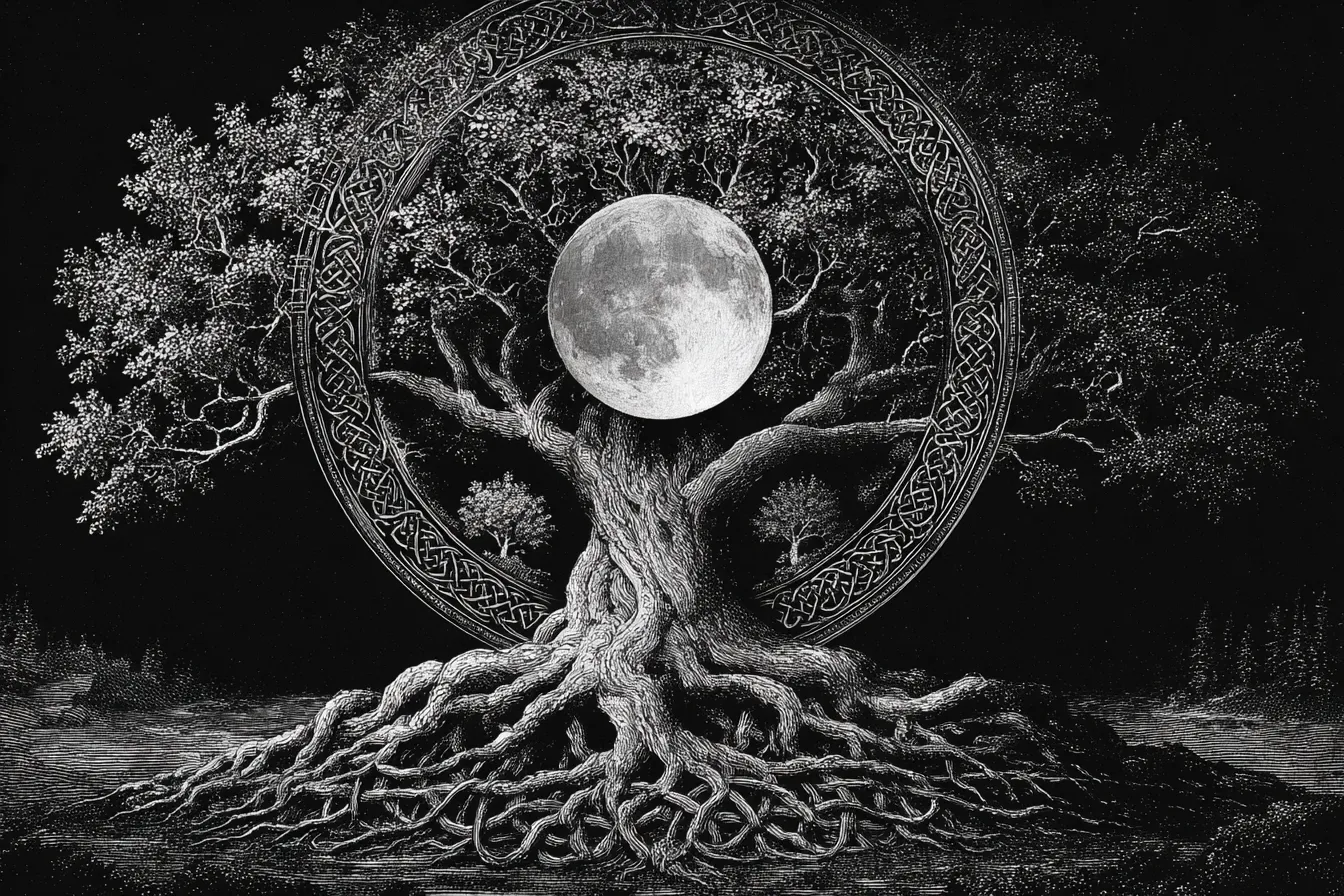
What is the Ash sign in Celtic astrology?
If your birthday falls between February 18 and March 17, the Celtic Tree Calendar places you under the Ash — the third tree, the world-spanner, the one whose roots reach as deep as its crown reaches high. Its Ogham letter is Nion (ᚃ), the third character in the ancient alphabet inscribed on standing stones across Ireland and the western coast of Britain. The Ash arrives after the Birch has cleared the ground and the Rowan has taken up its watchful position at the threshold — and it does something neither of them does: it reaches across. Up into what cannot yet be seen. Down into what cannot be directly known. Out toward what is distant and apparently unrelated. The Ash connects.
The Celtic Tree Calendar divides the year into thirteen lunar months, each linked to a tree whose ecology, mythology, and place in the material and symbolic life of the British Isles becomes a framework for understanding the character of those born within it. As with all articles in this series: the calendar as widely practised today draws primarily from Robert Graves’s The White Goddess (1948), a synthesis of genuine medieval Irish and Welsh sources filtered through Graves’s own scholarly interpretation. It is not a transcript of pre-Christian Celtic practice. The Ogham alphabet itself is genuinely ancient — inscriptions from the 4th through 8th centuries CE — and the associations Graves used have roots in real medieval texts including the Ogam Tract and the Book of Ballymote. Contemporary Druidry and Celtic spiritual practice have developed this system as a living tradition, and The Whisper engages with it in that spirit.
The Ash month spans the final weeks of winter and the first days of spring, containing the vernal equinox — the moment when light and dark balance exactly before the year tips irreversibly toward warmth. To be born in this period is to arrive at the hinge of the year, the exact point of the crossing.
The tree and its historical roots
The common ash (Fraxinus excelsior) is one of the most distinctive trees in the British and Irish landscape. It grows tall — commonly reaching thirty metres or more — with a straight trunk and a crown that is characteristically open and high, allowing light through to the ground below in a way that oak and beech do not. It is among the last native trees to come into leaf in spring and among the first to shed in autumn, spending a greater part of the year as bare silver-grey branches than almost any other deciduous tree. Those branches are forked, repeatedly, in a pattern that is both structural and visually striking: the ash always divides, always reaches in two directions simultaneously, always holds the tension of multiple paths.
The ash’s wood is remarkable. It is simultaneously extremely strong and extremely flexible — qualities that rarely coexist in timber. For this reason, ash was the wood of choice for the handles of tools and weapons across British and Irish history: axe handles, spear shafts, oar blades, wheel spokes, hurley sticks. A material that can absorb shock without breaking, that bends under force and returns to true — this is the ash’s specific physical gift, and it is inseparable from the symbolic associations the tree carries.
Nion means “ash” directly in Old Irish, and some sources associate the letter’s forked shape with the branching quality of the ash itself. The ash appears in the historical record with particular prominence: of the Five Sacred Trees of Ireland described in medieval sources — the trees whose felling was considered a catastrophic act — three were ash trees. The Bile Tortan, the Craeb Daithi, and the Craeb Uisnig were all ash, each associated with a specific sacred site and with the sovereignty of the land. The ash was not simply a useful or beautiful tree in the Irish tradition. It was a tree at the structural centre of things.
In Welsh mythology, the figure of Bran the Blessed (Bendigeidfran) in the Mabinogion is associated with the ash’s essential quality. When Bran’s army needed to cross a river with no bridge, Bran laid himself across it and let his people walk over him. The Welsh saying attributed to this act — a fo ben, bid bont, “he who would be chief, let him be a bridge” — captures something central to the Ash sign: the willingness, and the structural capacity, to be the thing that connects what cannot otherwise meet.
A note of genuine contemporary significance: the ash tree is currently facing ash dieback (Hymenoscyphus fraxineus), a fungal disease that has devastated ash populations across Europe and is spreading through the British Isles. An estimated eighty percent of British ash trees may be lost within decades. This is not symbolic — it is a real ecological crisis. For those who work with the Ash as a symbolic and spiritual presence, it adds a layer of urgency to the tree’s meaning that was not present in Graves’s time: the world-spanning connector is itself vulnerable, and what connects can also be broken.
The energy of Ash
The dominant quality of Nion is the perception of connection across apparent distance or difference. Not the Rowan’s precise watching for what is approaching along a known path, not the Birch’s pioneering into bare ground — the Ash’s particular quality is seeing that two things that appeared separate are in fact related, that the root system of one situation extends beneath the surface into another, that the solution to one problem is present in a completely different domain if you can see the bridge between them.
The ash tree does not connect things by building a bridge between them from the outside. It connects them by being the thing whose roots are in one place and whose crown is in another simultaneously — holding both not as a constructed mediation but as an intrinsic quality of its own nature. This is an important distinction for understanding the Ash sign. The Ash person does not necessarily try to connect things. They simply perceive the connections that are already there and name them.
The Ash month arrives at the vernal equinox — the moment when the year is precisely balanced between darkness and light before tipping toward spring. This timing is not accidental in its symbolism. The equinox is the moment of maximum balance, when two opposing forces are in exact equilibrium. The Ash’s quality of holding multiple things simultaneously — roots and crown, depth and height, the world above and the world below — is exactly the equinox quality: not a resolution of tension but a perfect, momentary holding of both.
There is also the quality of far reach in the Ash. The ash’s crown is high and open, catching light that the denser canopies of other trees would block. Its roots are wide-spreading rather than deep. The ash reaches far in every direction — it is not a concentrated, intensive presence like the oak, but an extensive one, present across a wide territory. The Ash energy carries this quality: a natural reach toward the distant and the apparently unrelated, a tendency to find the connection between things that others have not thought to look for.
Ash as a birth sign
As a birth sign, Ash describes a person whose particular gift is perceiving how things are related when others see only separation. Not as an intellectual exercise, not as a performance of systems thinking, but as a genuine perceptual quality — they simply see the underground root system that connects two apparently unrelated situations, and the seeing is immediate rather than reasoned.
People with strong Ash energy often find themselves in roles that require holding multiple things simultaneously — multiple perspectives, multiple disciplines, multiple people who are not naturally in communication with each other. They are often the person in the room who can translate between groups that cannot understand each other, not because they are diplomatic in the social sense but because they genuinely see what both groups are actually saying beneath their different vocabularies.
There is a quality to the Ash’s connective perception that can be simultaneously a gift and an exhausting one. When everything is connected to everything else and you can see how, the experience of apparent separation — a conflict, a failure of communication, a missed opportunity — is not just disappointing but almost physically uncomfortable, like seeing a bridge that clearly belongs across a gap and finding it is not there. The Ash’s instinct is always toward the spanning.
The forking branches are relevant here. The ash does not grow straight toward a single point — it divides, repeatedly, reaching in multiple directions at once. An Ash person rarely has a single, simple interest or a single, narrow focus. They tend toward the multiple, the convergent, the place where several things meet. This is a strength and also, at its growth edge, a source of difficulty: the tree that reaches in every direction simultaneously can have trouble committing the full weight of itself to any one branch.
The quality of Bran’s bridge is often present in Ash people in a practical way: they find themselves, sometimes without having chosen it, in the position of being the connection between things — the person who holds the relationship between two groups that would otherwise not communicate, the one who translates the insight from one field into the language of another, the one who lies across the gap so that others can cross. This is genuine service, and it carries genuine cost. The bridge feels the weight of everything that crosses it.
The Ash month as a seasonal energy
In The Whisper, the seasonal dimension of the Ash applies to the calendar period of February 18 through March 17 as an energy active for everyone. The Ash season is defined above all by the equinox — the crossing of the year’s balance point — and carries the quality of maximum equilibrium before the decisive tipping toward spring.
For those who do have Ash as their birth sign, the seasonal alignment intensifies the sign’s connective quality. The Whisper reads this as a period where the capacity to perceive and articulate connections is at its most available — and where the cost of that perception, the difficulty of so much spanning, is also most directly felt.
Seasonal position within the Ash month adds nuance. Those born in early Ash (February 18–24) arrive just after the Rowan’s threshold, carrying the freshest expression of the connecting quality — they have the Rowan’s perception in their recent background and the Ash’s reach opening ahead. Those born at or near the equinox (March 17–20 in most years) carry the balance quality most intensely — born at the exact hinge, equally between what was and what is coming. Those born in the final days of the Ash month (March 10–17) begin to approach the Alder threshold, and may find their connecting quality has a practical, grounding dimension — the bridge-builder who also knows how to build on uncertain terrain.
Strengths and growth edges
The strengths of the Ash are the strengths of genuine structural intelligence — the capacity to see and hold the system rather than only the components. In work that requires synthesis, translation, or the holding of multiple perspectives simultaneously, the Ash quality is indispensable. The ability to say this connects to that, and this is why — with genuine accuracy rather than forced analogy — is rare and genuinely useful in almost every domain of serious work.
The Ash also carries the strength of extraordinary resilience under pressure. Ash wood bends without breaking. The Ash person, in situations of genuine stress, often has access to a flexibility that others who appear stronger do not possess: they can absorb impact, return to true, and continue. This is not invulnerability — it is the specific structural quality of a material that has evolved to take force repeatedly without catastrophic failure.
The growth edges follow from the same source. The Ash’s reach in every direction — the natural tendency toward the multiple and the connective — can lead to a dispersal of depth. The tree that sends its roots wide rather than deep can find itself, in drought conditions, without the anchor that the deep-rooted trees have. An Ash person who has spent their energy in wide connection, in spanning and translating and bridging, can find in their own moments of difficulty that they have not cultivated the specific depth of rootedness in any single place that would sustain them.
The bridge cost is real and requires naming. Bran the Blessed laid himself across the river and let his army walk over him. The bridge in that story did not survive the crossing intact. The Ash’s quality of being the connective tissue between things that cannot otherwise meet is genuinely valuable — and it does extract something from the one who does it. An Ash person who does not have access to relationships or practices that are entirely for them, not bridges to something else, will eventually feel the weight of everything that has crossed.
There is also the growth edge of connection as avoidance of position. The Ash sees all sides, holds all perspectives, translates between all parties — and this capacity, in its shadow form, can become a way of never being required to take a side, never committing the full weight of oneself to a single view. The bridge is not the same as the ground. The Ash’s maturity involves knowing when to span and when to plant, when the connective function is genuinely what is needed and when it has become a way of avoiding the specific commitment that the situation actually requires.
What people get wrong about the Ash sign
The most common misreading of the Ash sign is as a purely intellectual quality — the systems thinker, the theorist, the one who lives in ideas and abstractions. This misses the most important thing about how the Ash’s connective intelligence actually works. The ash tree’s roots are in the soil. Its crown is in the air. The connection it makes is not between abstractions — it is between the living world below and the living world above. The Ash’s quality is not theoretical; it is perceptual. It sees the connections in lived situations, in relationships, in the texture of actual experience — not primarily in ideas about experience.
The second common error is reading the Ash as a peaceable, conflict-avoiding sign because of its connective function. The bridge between two opposing forces is not a neutral position. The ash’s wood is the material of spear shafts and axe handles precisely because it can deliver force and absorb the impact of the return. Bran the Blessed was a king and a warrior before he was a bridge. The Ash’s capacity to hold multiple perspectives is not the same as having no perspective. The connecting intelligence knows what it sees and what it believes — it is simply capable of also holding what others see and believe without being destabilised by the difference.
The third error is related: treating the Ash as a non-committal sign, as if the ability to see all sides were evidence of having no convictions. This is usually a misreading of the Ash’s mode of expression rather than its actual depth. An Ash person may take longer to commit to a public position than other signs — they are genuinely working through more variables — but the commitment, when it comes, is grounded in the full picture rather than a partial one.
What Ash means in The Whisper
In The Whisper, when Celtic is active in your oracle stack and your birth sign is Ash, the system reads your day through the Nion lens: the world-spanning connector, the bridge between what appears separate, the equinox-balance of holding multiple things simultaneously without forcing them to resolve.
The Ash finds its closest resonance in Western Astrology with Pisces, the sign that governs the same period. The resonance is genuine and goes beyond timing. Both Pisces and the Ash describe the experience of boundaries between things being permeable — the Piscean dissolution of separation and the Ash’s root-system connectivity are two expressions of the same underlying quality: the world is more entangled than it appears, and some people perceive this more directly than others. Where they differ: Pisces tends toward the oceanic, the feeling of merging, the loss of distinction between self and other. The Ash’s connectivity is more structural — it is not that the boundaries dissolve, but that the root system runs beneath them, connecting what appears separate without erasing the separateness on the surface. When the Whisper synthesis draws on both a Pisces placement and a Rowan birth sign, the reading often concerns the difference between these two modes: feeling the connection versus seeing the structure of it.
Runes offer a particularly rich parallel for the Ash, with the important caveat that runes are a Norse and Germanic tradition — a neighbouring culture’s wisdom system, not Celtic. The rune Ansuz (ᚨ) is associated in the Elder Futhark with the ash tree — or more specifically with Yggdrasil, the cosmic ash of Norse mythology whose roots reach into the realms of the dead and whose crown shelters the world of the gods. Yggdrasil is the Norse articulation of the ash as world-tree: the vertical axis that connects every realm of existence. It is crucial to say clearly that Yggdrasil is Norse, not Celtic — the two traditions, while they share the ash tree and certain northern European roots, developed entirely distinct mythological frameworks. The resonance is nonetheless real: both traditions perceived the ash as a tree of unusual vertical and connective reach, and Ansuz carries the specific quality of the breath that moves through the world-tree, the divine communication that is possible because the tree spans everything. When The Whisper draws on both Ansuz-resonant runic energy and an Ash birth sign, the synthesis tends toward the theme of communication as connection — the thing that needs to be said that only becomes possible when the bridge exists.
In BaZi, the Ash quality resonates strongly with Jia Wood (甲木) — the yang wood of the tall, straight-growing tree that reaches toward the sky while its roots go into the earth. Jia Wood in BaZi is the wood that grows with its nature rather than around obstacles — it does not bend the way Yi Wood does; it rises. It is direct, tall, principled, reaching. The Ash’s quality of holding the vertical axis — roots in one realm, crown in another — is the Jia Wood quality exactly: the living column that connects what is above and what is below by being fully both. When the Whisper synthesis draws on both a Jia Wood day master and an Ash birth sign, the reading often concerns genuine rather than strategic positioning: standing in the place you actually belong, tall and unambiguous, rather than the place that is convenient or socially comfortable.
In Numerology, Nion is the third Ogham letter, and the number 3 carries the quality of the third term — the synthesis that emerges from the tension between two opposing forces, the bridge between 1 and 2. Where the 1 initiates and the 2 perceives, the 3 connects and communicates: it is the number of the intermediary, the translator, the one who finds the third way. This is the Ash’s position in the Celtic sequence exactly, and its quality in the year: arriving after the Birch’s beginning and the Rowan’s watching, bringing the capacity to see that these two things — beginning and watching — are not opposed but are in fact a single movement. The 3 is often associated in numerology with expression, creativity, and communication. These are the downstream effects of genuine connection: when the bridge exists, words can cross it.
When The Whisper synthesis draws on multiple systems converging on this quality — the spanning connection, the equinox balance, the capacity to hold apparently opposing things — the reading concerns the specific bridge that is present or possible. Not bridges in general: this bridge, now, between these two things. The Ash’s gift is specific when it is genuine. The invitation is to name what you are connecting, and what that connection costs, and whether the spanning is genuinely needed or whether it is time to take root.
Frequently asked questions
Q: Is the Ash the same as the world-tree Yggdrasil? Yggdrasil, the cosmic ash of Norse mythology, is a Norse concept — not Celtic. The two traditions share the ash tree but developed entirely different mythological frameworks around it. Yggdrasil appears in Old Norse sources such as the Poetic Edda and the Prose Edda, and it is specifically a Norse articulation of the ash as the axis of the cosmos. In the Celtic tradition, the ash appears prominently in Irish mythology (three of the Five Sacred Trees of Ireland were ash trees) and in Welsh mythology through figures such as Bran the Blessed, but the world-tree concept as expressed in Yggdrasil is not directly attested in Celtic sources. The resonance between the Norse and Celtic uses of the ash is real and interesting — both traditions perceived the tree as having unusual connective and spanning qualities — but they are distinct traditions and should not be conflated.
Q: Is the Ash sign compatible with Pisces in Western astrology? The Ash month (February 18–March 17) almost exactly overlaps with Pisces (roughly February 19–March 20). Both carry the quality of permeability between things that appear separate — the Piscean dissolution of boundaries and the Ash’s deep connectivity. The resonance is genuine. Where they differ in emphasis: Pisces tends toward the oceanic, the felt experience of merging; the Ash is more structural, seeing the root system beneath the surface rather than experiencing the dissolution of the surface itself. The two together, in a Whisper synthesis, often produce readings about the relationship between feeling connected and understanding the structure of that connection.
Q: What does ash dieback mean for the Ash sign as a symbol? Ash dieback — the fungal disease currently affecting a significant proportion of ash trees across Europe and the British Isles — is a genuine ecological crisis, and it is worth acknowledging rather than ignoring. From a symbolic perspective, it is a reminder that the world-spanning connector is itself vulnerable, that what bridges things can also be broken, and that the loss of a connective element has consequences that extend far beyond the element itself. For those who work with the Ash as a meaningful symbol, the current vulnerability of the ash tree adds a contemporary urgency: the qualities the Ash represents — connection, the holding of multiple things simultaneously, the bridge — are qualities that require active tending. They are not permanent features of the landscape that can be taken for granted.
Q: Does the Ash sign indicate a particular career or life path? The Celtic Tree Calendar does not prescribe specific life paths — it describes qualities that can manifest across any domain. That said, the Ash’s core quality of perceiving and articulating connections across apparent distance or difference tends to be most visible in work that requires synthesis, translation, or the holding of multiple perspectives: research and writing that draws across disciplines, roles that require communication between groups who do not naturally understand each other, creative work that finds the unexpected connection between forms, therapeutic or coaching work that perceives the root system beneath a presenting problem. The Ash quality is not limited to these domains, but it tends to be most directly useful in them.
Q: My birthday is right at the equinox — is that significant? The vernal equinox falls within the Ash month, typically around March 20–21 (a few days after the Ash month ends on March 17, though the exact equinox date varies by year). If your birthday falls close to the equinox — whether in the final days of the Ash month or at the very beginning of the Alder month that follows — you carry the equinox quality of maximum balance: the exact moment when the year’s two great opposing forces are in equilibrium before the decisive tipping. In The Whisper, this position is read as an intensified version of the Ash’s core quality: not just the capacity to hold multiple things simultaneously, but a birth at the precise moment when the year itself is holding two things simultaneously and about to choose.