
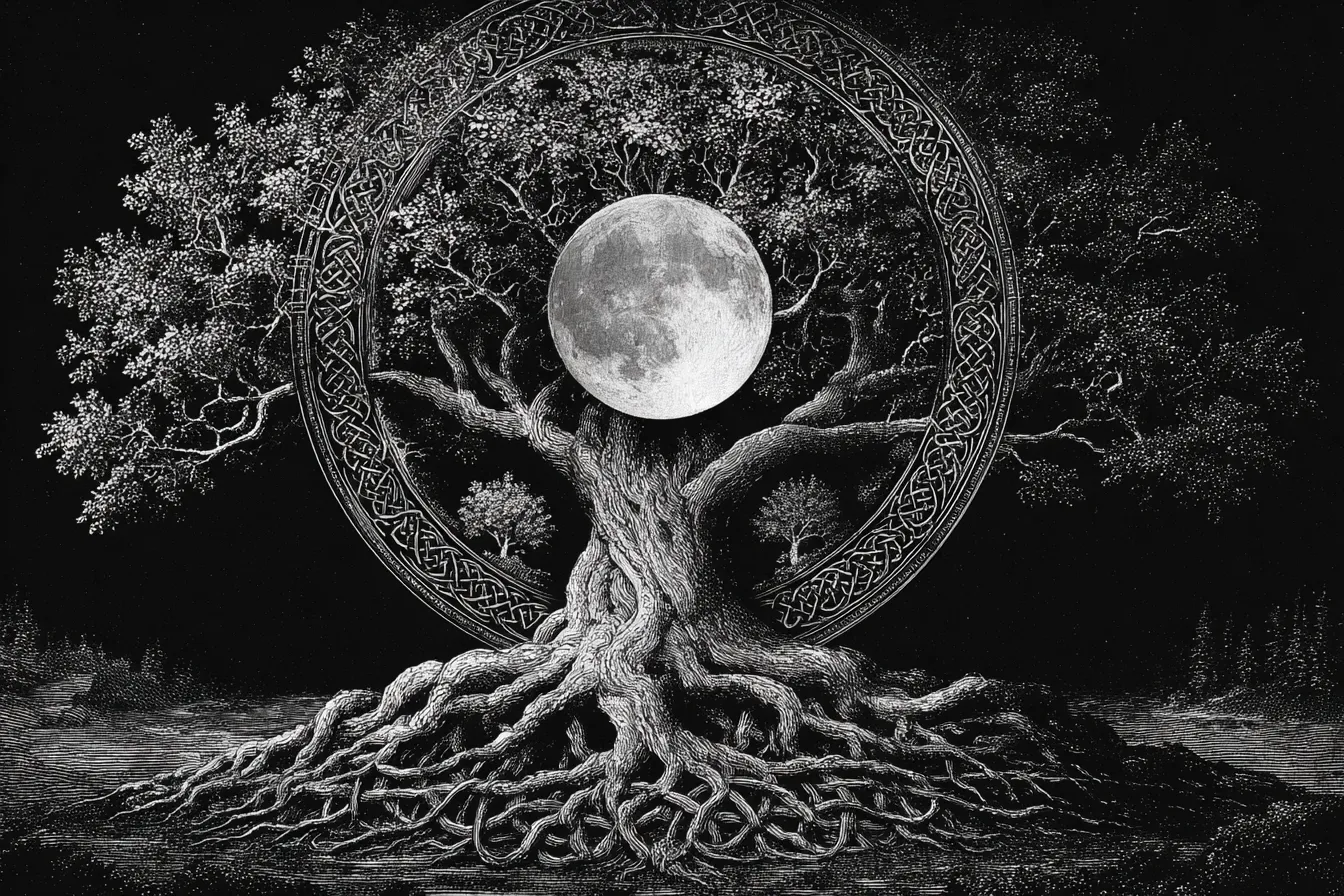
What is the Celtic Tree Calendar?
The Celtic Tree Calendar is a thirteen-month system in which each lunar month corresponds to a specific tree, and those born within a given month carry the qualities associated with that tree as a lens for understanding their character and the energies they move through. It is one of the oldest surviving frameworks for understanding the relationship between human beings and the natural world — and one of the most honest, if you take the time to understand what it actually is rather than what it is often claimed to be.
Each of the thirteen trees in the calendar is associated with a letter of the Ogham alphabet — one of the oldest writing systems in Ireland and Britain, with inscriptions carved on standing stones dating from the 4th through 8th centuries CE. The letters of Ogham take their names from trees and plants, and the symbolic meanings attributed to those trees draw on a real body of medieval Irish and Welsh literary and mythological sources. The system that links these letters and trees to specific birth months — giving each person a birth sign defined by a tree rather than a constellation — is the framework this guide explains.
Before going further, one thing deserves to be said plainly: the Celtic Tree Calendar as widely practised today owes its modern form primarily to Robert Graves’s The White Goddess (1948), a work of extraordinary poetic and mythological synthesis that drew on genuine ancient material through Graves’s own interpretive vision. It is not a direct transcript of pre-Christian Celtic religion, and no single ancient source presents the complete thirteen-month, thirteen-tree, birth-sign system that modern Celtic astrology uses. The Ogham alphabet is genuinely ancient. The tree associations have genuine roots in medieval Irish sources. The living practice of contemporary Druidry and Celtic spirituality has developed this system with seriousness and depth. All of this is true, and The Whisper engages with it accordingly — as a meaningful, historically grounded framework, not as a fixed ancient revelation.
With that foundation in place: what does it actually tell you?
How the Celtic Tree Calendar works
The Celtic year is divided into thirteen lunar months, each lasting approximately twenty-eight days, each governed by a specific tree. The months begin at the winter solstice — December 24 in the modern calendar — and proceed through the year in the sequence of the Ogham alphabet: Birch (Beith), Rowan (Luis), Ash (Nion), and so on through to Elder (Ruis), which ends on December 23 and closes the cycle one day before it begins again.
Your birth sign is determined simply by which month your birthday falls within. If you were born between June 10 and July 7, your birth tree is the Oak; between August 5 and September 1, the Hazel; between November 25 and December 23, the Elder. Unlike Western astrology, which requires calculating the exact position of the sun at your birth, the Celtic Tree Calendar requires only your birth date. The simplicity is deliberate — the system is not calculating an astronomical position but identifying your place in the year’s natural cycle.
Beyond the birth sign, the calendar also carries a seasonal dimension: the current calendar date falls within one of the thirteen months, and that month’s tree quality is active as an energy available to everyone, regardless of their birth sign. In The Whisper, both layers — the personal birth tree and the seasonal tree of the current day — contribute to the daily synthesis.
The Ogham alphabet and its tree names
The Ogham alphabet consists of twenty characters, each a series of strokes cut across or along a central stemline. The first thirteen letters — the ones corresponding to the Celtic Tree Calendar months — each carry the name of a tree or plant: Beith (birch), Luis (rowan), Nion (ash), Fearn (alder), Saille (willow), Huath (hawthorn), Duir (oak), Tinne (holly), Coll (hazel), Muin (vine), Gort (ivy), Ngetal (reed), and Ruis (elder).
This naming convention — letters named for trees — is one of the strongest threads connecting the modern Celtic astrology tradition to genuinely ancient material. The tree associations are not Graves’s invention; they are present in medieval Irish texts including the Ogam Tract in the Book of Ballymote and in the poetic tradition of the fileadha (Irish poets and seers), who used the Ogham tree names as a private, encoded vocabulary. When the modern Celtic Tree Calendar assigns Coll (hazel) to the harvest month of August-September, it is drawing on a real ancient association between the hazel and wisdom — the same association that underlies the Irish mythology of the nine hazels of wisdom and the Salmon of Knowledge.
The four fire festivals
The Celtic Tree Calendar does not stand alone — it moves in relationship to the four great fire festivals that mark the quarter-points of the year. Understanding which festivals fall within which tree months makes the seasonal dimension of each sign much more precise.
Imbolc (around February 1–2) falls within the Rowan month. It is the festival of the first stirring — the ewes’ milk returning, the first snowdrops, the sacred flame tended through winter beginning to reach outward. The Rowan’s quality of acute perception and the quickening of what is dormant is directly aligned with Imbolc’s energy.
Beltane (May 1) falls within the Willow month (ending May 12), though the flowering it marks is most directly expressed in the Hawthorn month that follows. The Willow’s lunar, dreaming preparation enables the full Beltane flowering that the Hawthorn carries.
Lughnasadh (August 1) marks the first harvest and falls just before the Hazel month begins (August 5). The Hazel’s concentrated, earned, first-harvest wisdom is Lughnasadh’s quality carried forward into the month.
Samhain (November 1) falls within the Reed month (October 28–November 24). Samhain is the year’s most significant threshold — the thinning of the veil, the presence of what lies beyond ordinary life — and the Reed’s quality as the hollow instrument at the threshold is precisely suited to hold this festival.
The 13 tree signs: a seasonal guide
The thirteen trees divide naturally into four seasonal groupings that reflect the underlying rhythm of the year. Each sign is described briefly here; follow the link to the full article for the complete depth of each tree’s mythology, ecology, character, and cross-system resonances.
The winter threshold: December 24 – March 17
Birch (Beith) — December 24–January 20 The first tree, the pioneer. The Birch colonises bare, cold ground before any other tree can establish itself — it does not wait for hospitable conditions but moves because moving is what is needed. Birch people carry a genuine capacity for beginning again, especially from difficult ground. The luminous white bark that glows in the darkest winter light is its defining image: not warm, but unmistakably real.
Rowan (Luis) — January 21–February 17 The bright protector, the tree of acute perception. The rowan grows at the tree line — the outermost threshold — and its red berries against the snow are one of the most precisely visible signals in the winter landscape. Rowan people see specifically: what is approaching before it arrives, what is dormant and ready to stir. The Imbolc threshold falls within this month. The five-pointed star on each berry base is the sign of protection through precision.
Ash (Nion) — February 18–March 17 The world-spanner, the connector across apparent distance. The ash’s roots reach as deep as its crown reaches high — it connects what is below with what is above, what is here with what appears to be elsewhere. The spring equinox falls within the Ash month, and the equinox’s quality of exact balance before the decisive tipping toward warmth is the Ash’s quality: holding multiple things simultaneously, spanning the distance between worlds.
The spring flowering: March 18 – June 9
Alder (Fearn) — March 18–April 14 The foundation-builder in impossible terrain. Alder wood does not rot underwater — it hardens — and the foundations of Venice were driven into the Venetian lagoon on alder pilings a thousand years ago. Alder people build what holds in the ground that should not support it. The bridge quality of Bran the Blessed — a fo ben, bid bont, “he who would be chief, let him be a bridge” — is the Alder’s defining story.
Willow (Saille) — April 15–May 12 The lunar dreamer, the flexible root. The willow holds the riverbank with an invisible, wide-spreading root system while its branches sweep freely in the current above. Willow people carry a deep, tidal, flowing intelligence that does not reason its way to knowing but arrives through the dreaming route beneath the surface. Beltane falls within this month; the Willow’s preparation is what enables the flowering. Willow bark’s genuine pharmaceutical property — the precursor of aspirin — grounds its healing associations in fact.
Hawthorn (Huath) — May 13–June 9 The fairy threshold, the joy that contains the knowledge of thorns. The hawthorn is the tree of Beltane’s full flowering and simultaneously the tree most deeply associated with fairy dwellings in Irish and British folk tradition. Its Ogham letter Huath is associated in medieval sources with dread as well as joy. Hawthorn people are fully, extravagantly present at the boundary between ordinary and extraordinary — thorns and blossom both, without reducing either.
The summer and harvest: June 10 – September 1
Oak (Duir) — June 10–July 7 The king of the forest, the tree at the apex of the year’s light. The summer solstice falls within the Oak month, and the Oak’s defining context is the peak of full expression that is simultaneously the turning point: the solstice is the longest day, and also the day after which the light begins to wane. Oak people carry a sustained, complete, unhesitating presence that generates conditions for many other lives — a single mature oak supports over 500 species of invertebrates. The word Druid may derive from the same root as Duir: the oak-knower.
Holly (Tinne) — July 8–August 4 The evergreen iron, the waning year’s steadfast presence. Holly takes over from the Oak at midsummer and governs the period of maximum heat in declining light — the year’s warmest weeks within a structure already moving toward autumn. Holly leaves adapt their spine production to actual browsing pressure: dense spines on lower branches, fewer or absent above browsing height. This calibrated intelligence — precise defense where it is needed, genuine openness where it is not — is the Holly’s most sophisticated quality.
Hazel (Coll) — August 5–September 1 The wisdom tree, the salmon’s secret. The nine hazels of wisdom in Irish mythology grow over the Well of Segais; their nuts fall into the water and are eaten by the Salmon of Wisdom. The hero Fionn mac Cumhaill burns his thumb on the cooking salmon and puts it in his mouth — and in that instant receives the full wisdom of the hazelnuts. Hazel wisdom is not abstract or scholarly; it arrives through the burned thumb, through direct physical contact with the actual. The first harvest festival of Lughnasadh precedes this month; the Hazel carries its concentrated, precisely timed knowing forward.
The autumn descent: September 2 – December 23
Vine (Muin) — September 2–September 29 The harvest abundance of the winding path. The vine finds its way to the light through and around the existing structure — it does not grow straight, it grows through. The autumn equinox falls within the Vine month, and the equinox balance — light and dark in exact equilibrium before the tipping toward darkness — is the Vine’s defining moment. The blackberry, the ecologically accurate British equivalent of the vine, should not be eaten after Michaelmas (September 29): the Vine’s harvest window is specific and seasonal.
Ivy (Gort) — September 30–October 27 The spiral persistence that transforms what it covers. Ivy does not kill trees — it is epiphytic, not parasitic, and ivy coverage can actually benefit its host. What the ivy does is transform what has been left behind into something living again: the abandoned wall becomes habitat, the ruined building becomes shelter for dozens of species. The Celtic spiral motif — the triple spirals of Newgrange — is the ivy’s growth pattern made ancient. Samhain approaches through the Ivy month.
Reed (Ngetal) — October 28–November 24 The Samhain threshold, the hollow that carries what it does not originate. The reed’s physical structure — a hollow grass — is the basis of the oldest musical instruments in human history, and the music is possible not because of anything the reed produces but because the reed is hollow enough for the breath to pass through. Samhain falls within this month: the veil at its thinnest, the threshold between the living and the dead at its most permeable. Reed people carry the specific quality of the shaped, maintained hollowness that enables transmission.
Elder (Ruis) — November 25–December 23 The crone wisdom, the cycle-closer. The elder is the thirteenth and last tree — the number outside the twelve-fold pattern, the one that holds what the cycle cannot quite contain. The winter solstice falls within the Elder month, and the Elder’s defining act is holding the darkness to its full depth and then handing the year forward to the Birch’s new beginning. Elderberries are toxic raw and medicinal when properly prepared: the Elder’s wisdom requires transformation before it heals. The Cailleach — the ancient winter goddess of Irish and Scottish Gaelic tradition — is the Elder’s divine form.
Celtic tree signs and Western astrology: how they relate
The Celtic Tree Calendar and Western Astrology are entirely independent systems that arrive at similar seasonal qualities from different directions. Because the Celtic Tree Calendar is a solar-lunar calendar and Western Astrology is based on the sun’s position, the two systems overlap approximately but not precisely.
The most direct correspondences are with the signs that govern the same calendar periods: Capricorn with Birch (winter solstice, serious initiation), Aquarius with Rowan (independent perception), Pisces with Ash (spanning connectivity), Aries with Alder (first spring action), Taurus with Willow (sensory depth), Gemini-Taurus cusp with Hawthorn (threshold intelligence), Cancer-Gemini cusp with Oak (protective centrality), Cancer-Leo with Holly (sustained full expression), Leo-Virgo with Hazel (harvest precision), Libra with Vine (equinox balance), Libra-Scorpio with Ivy (threshold transformation), Scorpio with Reed (depth and threshold), and Sagittarius with Elder (philosophical wisdom).
These correspondences are resonances rather than equivalences — two traditions observing the same seasonal reality through different lenses, arriving at related but not identical descriptions. The Whisper uses both systems in its synthesis, and when they converge on the same quality in the same day’s reading, the synthesis tends to produce unusual clarity about what the day is actually asking.
How The Whisper uses Celtic astrology
In The Whisper, Celtic astrology is one of fifteen divination systems available in your oracle stack. When Celtic is active, the system reads on two levels simultaneously:
Your birth tree — determined by your birth date — provides the personal lens: the specific qualities, challenges, and forms of intelligence associated with the tree you were born under. This layer is fixed and unique to you.
The seasonal tree — the tree governing the current calendar date — provides the temporal quality: the energy of this specific period in the year’s cycle, available to everyone and interpreted through the lens of your birth tree. When your birth tree and the current seasonal tree are the same — when your own month comes around — the Whisper reads this as a period of intensified alignment between your personal nature and the year’s current energy.
Celtic astrology’s specific contribution to The Whisper’s synthesis is seasonal and ecological grounding: where Western Astrology tracks the sky and BaZi tracks the cycles of heaven and earth in a Chinese cosmological framework, the Celtic system roots the reading in the specific character of the natural world in the British Isles and northern Europe — the trees, the festivals, the actual ecology of the place where the tradition emerged. When all three systems converge on the same quality, the synthesis is unusually grounded in both the cosmic and the natural.
Frequently asked questions
Q: How do I find my Celtic tree sign? Find your birth date in the list of thirteen date ranges above. The tree whose dates include your birthday is your birth tree. If you were born on a day that falls at the boundary between two months — for example, on March 17 (the last day of Ash) or March 18 (the first day of Alder) — The Whisper uses a consistent set of dates across the application, so your sign will be stable and clear within the app regardless of slight variations between different versions of the calendar.
Q: Is Celtic astrology the same as Celtic horoscopes I’ve seen online? Celtic astrology as practised in The Whisper and as described in this guide is a specific, internally consistent system based on the thirteen-tree Ogham calendar. Some websites describe “Celtic horoscopes” using entirely different systems — sometimes associating dates with animals rather than trees, sometimes using a different number of signs, sometimes attributing the system to Druids without acknowledging its modern origins. The Whisper uses the thirteen-tree system described here, which has the best-documented connection to genuine Ogham material and the most coherent seasonal logic.
Q: Can the Celtic Tree Calendar be used alongside Western astrology? Yes — and this is central to how The Whisper works. The two systems are not in competition; they describe different aspects of the same reality through different lenses. Western Astrology tracks the position of the sun and planets at the moment of birth; the Celtic system tracks the position of the birth date within the natural year’s cycle. In The Whisper’s synthesis, both layers are active simultaneously when both systems are in your oracle stack. The convergences between them — the moments when both point at the same quality — tend to be the most precise and useful readings.
Q: What is the difference between Celtic astrology and Druidry? Celtic astrology as described here is a divinatory and self-reflection system — a framework for understanding character and seasonal energies through the symbolism of thirteen trees. Druidry is a broader spiritual and philosophical tradition that encompasses cosmology, ethics, relationship with the natural world, ceremony, and community practice. Many people who practise Druidry use the Celtic Tree Calendar as one element of their practice, but the calendar is not the whole of Druidry, and using the Celtic Tree Calendar for self-reflection does not make one a Druid. The Whisper uses the Celtic Tree Calendar as a wisdom framework for personal insight, in the same spirit it uses BaZi, the I Ching, and Vedic astrology — as a lens for understanding, not a religious affiliation.
Q: Why are there thirteen trees rather than twelve? The number thirteen corresponds to the number of full moons in a solar year — most years contain thirteen lunar months of approximately twenty-eight days each, rather than twelve. The Celtic calendar, like many ancient lunar-solar calendars, accommodates this extra moon by having thirteen months rather than twelve. Thirteen is also the number that exceeds the neat twelve-fold pattern — the number that stands outside the complete cycle and holds what the cycle cannot quite contain. This is the Elder’s position exactly: the thirteenth tree, the cycle-closer, the one that holds what the pattern cannot include and then hands the year forward to the beginning.