
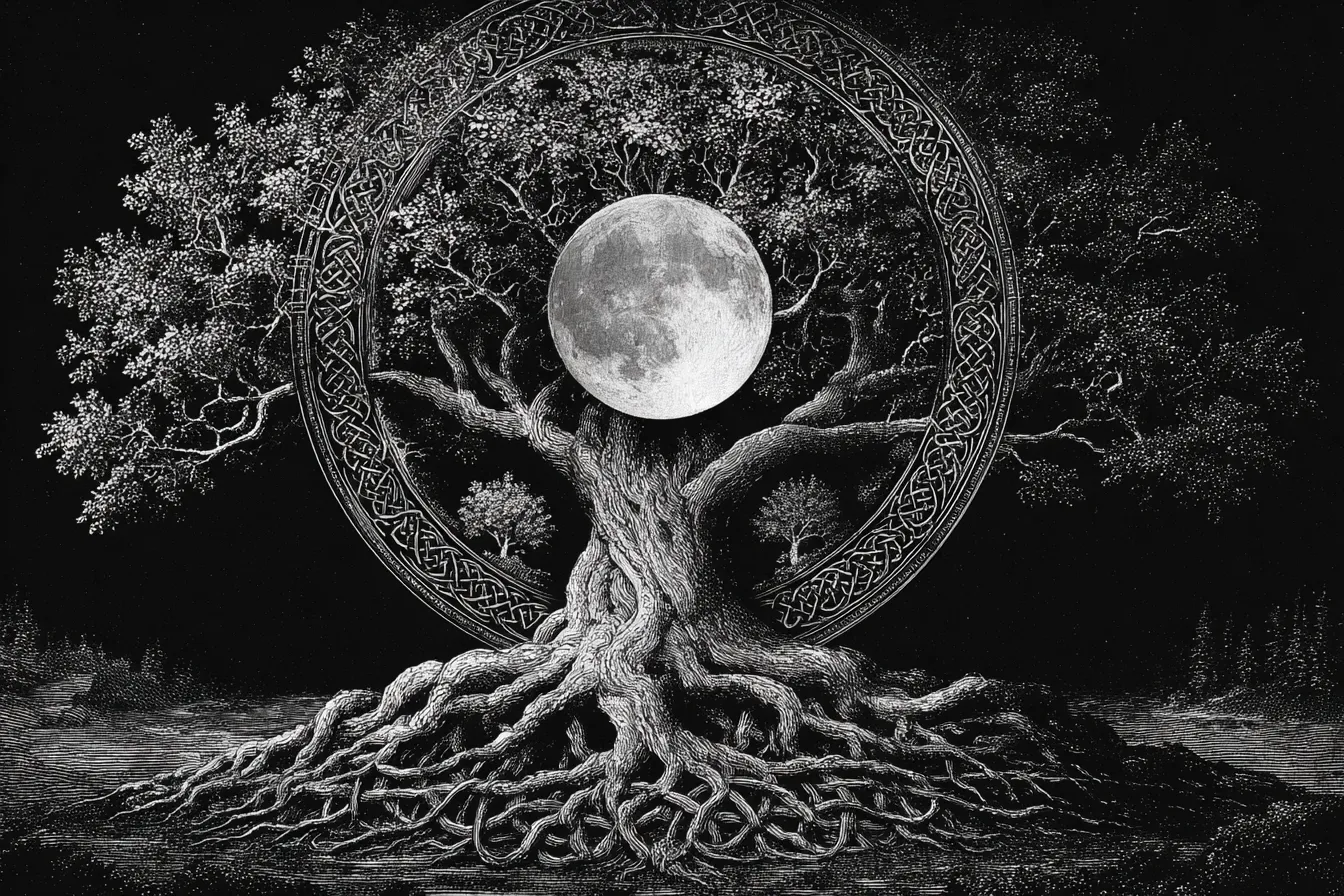
What is the Hazel sign in Celtic astrology?
If your birthday falls between August 5 and September 1, the Celtic Tree Calendar places you under the Hazel — the ninth tree, the wisdom tree, the one whose nuts contain the distilled knowledge of the world. Its Ogham letter is Coll (ᚉ), the ninth character in the ancient alphabet inscribed on standing stones across Ireland and western Britain. Of the thirteen trees in the Celtic calendar, the Hazel has the most extensive and the most specifically wisdom-oriented mythology in the Irish and Welsh record. It is not the king’s tree like the oak, not the world-spanning connector like the ash — the Hazel’s domain is the specific, concentrated, earned, practical knowing that comes from genuine engagement with the world over time. The nut is small, dense, and complete. Everything necessary is in it. Nothing is wasted.
The Celtic Tree Calendar links each of its thirteen lunar months to a tree whose ecology, mythology, and material life in Ireland and Britain becomes a framework for understanding those born within it. As in every article in this series: the calendar in its modern form draws primarily from Robert Graves’s The White Goddess (1948), synthesising genuine medieval Irish and Welsh sources through Graves’s interpretive lens. It is not a transcript of pre-Christian Celtic practice. The Ogham alphabet is genuinely ancient — stone inscriptions from the 4th through 8th centuries CE — and the symbolic associations draw on real medieval textual sources. Contemporary Druidry and Celtic spiritual practice engage with this as a living tradition. The Whisper does the same.
The Hazel month begins in early August and runs through the first day of September. Lughnasadh — the great harvest festival of August 1, one of the four Celtic fire festivals — falls just before the Hazel month begins, and its energy bleeds directly into the Hazel season: the first fruits, the first harvest, the first taking of what has genuinely ripened. The hazel’s own nuts are ready in late August and early September. The Hazel sign arrives with the harvest already beginning around it.
The tree and its historical roots
The common hazel (Corylus avellana) is one of the oldest native trees in Britain and Ireland, among the first to recolonise after the last ice age, arriving before oak, ash, and most other forest species. It grows not as a single trunk reaching toward the sky but as a multi-stemmed shrub or small tree, sending up multiple shoots from the base — a growth form that makes it the ideal coppice tree. Coppicing is the practice of cutting a tree back to its base on a regular cycle — every seven to fifteen years, in traditional practice — and hazel responds to this cutting with extraordinary regenerative productivity: from a single cut stool, a hazel will produce dozens of straight, flexible rods that can be harvested again in the next cycle. The hazel that has been coppiced for a century is not diminished — the stool grows older, the root system deeper, and each cycle’s harvest as abundant as the last. This is a tree that becomes more productive through being cut back.
The practical role of hazel in Celtic material culture was immense and largely invisible in the historical record precisely because hazel products were so thoroughly used and so thoroughly perishable: wattling for the walls of houses (wattle and daub construction), hurdle fencing for livestock, fish weirs, baskets, water containers, tool handles, and the frames of coracles. The hazel was not a prestige material like oak — it was the everyday, essential, irreplaceable material that daily life was built from. Hazel rods, hazel wands, hazel baskets: these were the connective tissue of the material world.
The hazel’s nuts — hazelnuts, ripening in late August and September — are among the most nutritionally dense and practically storable of any native British wild food. They were a primary food source in the pre-agricultural Mesolithic period and remained a significant food source through the medieval period. Unlike most fruit, a hazelnut can be stored through the winter; unlike roots and grains, it requires no preparation. It is complete in itself, small and portable, everything necessary already enclosed in the hard shell.
Coll means “hazel” in Old Irish, and some sources also connect the word to ceann (head) — the head as the seat of wisdom, the concentration of knowing in a specific, bounded container. The hazel wand held by the Irish fileadha (poets and seers) was not decorative but functional: it marked the holder as one with authority to speak, to judge, to prophesy. The hazel wand of the dowser is still used in folk practice to find water and hidden things underground — the specifically practical magic of finding what is genuinely there, beneath what is visible, through a form of knowing that cannot fully account for itself but that arrives at accurate results.
The mythological heart: the Salmon of Wisdom
The central myth of the Hazel in Irish tradition is one of the most important stories in the entire mythological corpus, and it deserves careful attention because it says something precise about what the Hazel’s wisdom actually is.
In the mythological geography of Ireland, there is a spring — the Well of Segais, also called Connla’s Well — located at the source of the River Boyne or the River Shannon, depending on the version. Around this well grow nine sacred hazel trees, whose nuts, when they fall into the water, contain the sum of all knowledge and all poetry in the world. A magical salmon — the Bradán Feasa, the Salmon of Wisdom — lives in the well and eats the hazelnuts as they fall. By eating the nuts, the salmon accumulates all the wisdom they contain. Whoever eats the salmon will receive everything the salmon knows.
The poet and seer Finnegas had spent seven years seeking the Salmon of Wisdom in the River Boyne. When he finally caught it, he set his apprentice — the young Fionn mac Cumhaill (Finn MacCool, the great hero of Irish mythology) — to cook it, with the strict instruction not to eat any of it. While cooking, Fionn burned his thumb on the fish and put it in his mouth to cool the burn. This was enough. The wisdom of the hazelnuts, transmitted through the salmon, entered Fionn through his burned thumb. From that moment, whenever Fionn placed his thumb in his mouth, he received prophetic insight. The wisdom was not studied or earned through long years of scholarship — it arrived through an accident, through physical sensation, through the body’s immediate response to heat.
Several things in this story are worth sitting with. The wisdom of the hazel is not abstract or theoretical — it is encoded in a nut, concentrated into a specific, complete form. The salmon eats the nuts and contains the wisdom; the salmon is eaten and the wisdom is transmitted. The whole sequence is physical, specific, and immediate: the nine hazels drop their nuts into the water, the salmon eats, Fionn burns his thumb, Fionn knows. No long lineage of teaching, no years of study, no gradual accumulation — the hazel’s wisdom arrives suddenly, completely, through direct physical contact with the thing itself. This is not the wisdom of the library; it is the wisdom of the burned thumb.
The energy of Hazel
The dominant quality of Coll is concentrated, specific, earned, practical wisdom. Not the world-spanning perception of the Ash, not the deep, tidal, flowing knowing of the Willow — the Hazel’s quality is something different: a knowing that is dense, complete, specific, and above all useful. The hazelnut contains everything necessary. The Salmon of Wisdom knows everything because it has eaten the nuts. The burned thumb accesses it all at once.
This wisdom has a specific quality that distinguishes it from other forms of knowing. It is not theoretical. The hazel wand that finds water underground is not reasoning about hydrology; it is responding to what is actually there. The fileadha with their hazel wands were not performing scholarship — they were practising a form of knowing that worked through direct contact with the thing itself. The Hazel quality is the knowing that arrives through genuine engagement with actual experience, distilled into something dense and complete and immediately applicable.
The Lughnasadh quality — the first harvest — is central to the Hazel month’s energy. Lughnasadh is the festival of the first fruits: not all the harvest, but the first. The specific wisdom of the first harvest is knowing when something has genuinely ripened. Not before — the unripe fruit is not yet what it will be. Not after — the overripe fruit has already begun its return to the soil. The exact moment of ripeness is the Hazel’s intelligence: the capacity to discern what is genuinely ready from what is not yet or no longer ready.
The coppicing quality adds another dimension: the wisdom that multiplies through being cut back. The hazel that has been cut to its base produces more rods, more abundantly, than the hazel that has never been coppiced. This is not intuitive — the cutting looks like diminishment. The result is expansion. The Hazel quality in a person includes the specific form of wisdom that deepens and multiplies through the experiences that appear to cut it back: difficulty, failure, the stripping away of what was not genuinely the thing, the return to the root from which something more productive can grow.
Hazel as a birth sign
As a birth sign, Hazel describes a person whose particular gift is the specific, earned, practically applicable form of wisdom that arrives through genuine engagement with experience. Not the wisdom of the scholar who has read everything — the wisdom of the person who has cooked the salmon, burned their thumb, and put it in their mouth. Not necessarily by design; often by accident or necessity. But the accumulation of that kind of knowing, over time, produces a depth and density of practical intelligence that is the Hazel’s specific gift.
People with strong Hazel energy often carry a quality that others recognise as wisdom without quite being able to explain what makes it different from knowledge. The distinction is real: the Hazel person knows things in a way that is immediately applicable, specific to the actual situation, and not dependent on general principles being demonstrated to be correct before they can be used. They may not be able to fully explain how they know — like the burned thumb, the route of arrival is not always traceable. But the knowing is accurate, and it is available when it is needed.
The precision of the Hazel is related to this quality. The dowsing rod does not find water everywhere; it finds water where water is. The hazel wand of the fileadha marked the person with the specific authority to speak on this subject, in this context — not a general license to pronounce on everything. The Hazel quality is precise in this sense: it knows what it knows with great specificity, and it tends not to generalise beyond the actual territory of genuine knowing. This precision can look like modesty from the outside — the Hazel person who says “I don’t know” about things they genuinely don’t know, alongside “I know this exactly” about the things they do.
The multi-stemmed growth of the hazel — no single central trunk, but multiple stems from a common root — manifests in Hazel people as a quality of multiplicity rather than singular centrality. Where the Oak is the king of the forest with its single great trunk, the Hazel has many expressions from the same root. The Hazel person often has multiple areas of genuine competence rather than a single towering expertise — multiple stems from the same wisdom root, each producing its own quality of knowing.
The Hazel month as a seasonal energy
In The Whisper, the seasonal dimension of the Hazel applies to the calendar period of August 5 through September 1 as an energy active for everyone. The Hazel season is defined by the first harvest — the festival of Lughnasadh, which has just passed as the Hazel month begins, and the ripening of the hazel’s own nuts through August.
The Hazel season carries a specific invitation: the invitation to take what has genuinely ripened. Not everything in the field — the first harvest is not the full harvest. The specific wisdom of the Hazel month is the discernment of what is ready: what has been worked toward long enough, cultivated carefully enough, grown in good enough conditions, and is now genuinely, completely, appropriately ready to be taken. The hazelnut in its shell, knocked from the tree at exactly the right moment of maturity, is the seasonal archetype.
Seasonal position within the Hazel month adds nuance. Those born in early Hazel (August 5–14) arrive closest to the Lughnasadh threshold — the first fruits energy is freshest here, the harvest wisdom most directly present. Those born in the heart of the month (August 15–22) carry the fullest Hazel quality, the point at which the nuts are ripening most densely. Those born in late Hazel (August 23–September 1) begin to approach the Vine threshold — the late Hazel carries the quality of harvest wisdom meeting the approaching autumn equinox, the deepening sense of what the season has produced.
Strengths and growth edges
The strengths of the Hazel are the strengths of genuine earned knowing. The capacity to arrive at specific, accurate, practically applicable wisdom through genuine engagement with experience — and to offer that wisdom precisely when and where it is needed, without generalising it into abstraction — is rare and genuinely valuable. The burned thumb that grants Fionn his gift is not a metaphor for careful scholarship: it is the acknowledgment that the deepest wisdom arrives through direct contact with the actual, often uncomfortable, always specific texture of experience.
The precision is a related strength: knowing specifically what you know, and specifically what you do not know, and not confusing the two. This produces a form of authority that is genuinely reliable because it is genuinely accurate — it does not overreach, it does not claim territory beyond the actual ground of its knowing.
The coppice quality — the productivity that multiplies through being cut back — is a strength that is only recognisable in retrospect. The experience that appears to strip the Hazel person back often produces, from the same root, a richer and more various expression of their capacity than the original uncut growth contained.
The growth edges are the shadows of the same qualities. The precision that knows exactly what it knows can become the withholding of what is known from those who need it. The hazelnut in its shell, not knocked from the tree, remains on the branch. The wisdom that is held rather than offered because the conditions for offering it do not feel precisely right — because the person asking does not seem ready, or the context is not ideal, or the moment is not exactly correct — can become a form of hoarding that serves no one. The Hazel’s maturity involves learning to offer the nut at the moment of genuine ripeness, not at the moment of absolute certainty about the receiver’s readiness.
The multi-stemmed quality can become dispersal without depth: many interests, many competencies, many areas of genuine knowing, none of them given the sustained cultivation that would take them to the full depth of which the Hazel root is capable. The coppiced hazel produces abundant rods, but the single-stemmed hazel grows larger. The question for the Hazel person is whether the multiple stems are the appropriate expression of their root’s nature, or whether the dispersal has become a way of avoiding the specific commitment of depth in a single direction.
There is also the growth edge of the precision that becomes perfectionism: the hazel wand that will only find water when the conditions are exactly right, the wisdom that will only be offered when the context is precisely appropriate. The first harvest is not perfect fruit — it is genuinely ripe fruit, which is not the same thing. The Hazel’s wisdom about ripeness needs to include the wisdom of genuinely good enough.
What people get wrong about the Hazel sign
The most common misreading of the Hazel sign is as primarily intellectual or scholarly — the bookish one, the researcher, the person whose wisdom is found in libraries. This misses the most important thing about the Hazel’s knowing: it arrives through the burned thumb, not through the read page. The Hazel’s intelligence is practical, specific, and experientially grounded — it is more like the knowledge of an experienced craftsperson than the knowledge of a theorist. Hazel people may or may not be scholarly; the Hazel quality is orthogonal to academic attainment. What the Hazel knows, it knows because it has cooked the salmon, not because it has studied the salmon’s properties.
The second common error is treating the Hazel as a quiet or modest sign — the wise background figure, the one who knows but does not speak, the reservoir of wisdom that does not seek attention. This sometimes reflects genuine Hazel qualities — the precision that does not generalise beyond its actual ground, the withholding until the moment is right. But it can also be a misreading of the Hazel’s specific authority. The fileadha with their hazel wands were not background figures; they were the people whose authority to speak was marked and recognised in the formal structures of Celtic society. The Hazel’s wisdom is meant to be used, offered, and shared at the moment of genuine ripeness — not hoarded.
The third misreading treats the Hazel’s precision as coldness or emotional distance — the analytical quality mistaken for the absence of feeling. The burned thumb is a visceral, physical, immediate experience. Fionn’s wisdom came through his body’s pain, not through detached observation. The Hazel’s precision is not the precision of someone who has stepped back from experience to analyse it; it is the precision of someone who has been in such direct contact with the actual that they know exactly what it is. This is often emotionally alive rather than emotionally distant — the specificity is the sign of genuine contact, not the absence of it.
What Hazel means in The Whisper
In The Whisper, when Celtic is active in your oracle stack and your birth sign is Hazel, the system reads your day through the Coll lens: the concentrated wisdom earned through genuine contact with experience, the first-harvest discernment of what has genuinely ripened, the multi-stemmed productivity that deepens through being cut back.
The Hazel’s calendar month spans the end of Leo and the beginning of Virgo in Western Astrology — the Hazel month begins on August 5, while Leo runs until approximately August 22–23, and Virgo begins from there through the remainder of the Hazel month. The resonance with this cusp is genuine and layered. Leo’s quality of sustained, full expression through the waning light — which resonates with the Holly’s preceding month — gives way to Virgo’s quality of precise, analytical, harvest-timing intelligence. The Virgo correspondence with the Hazel is particularly direct: both describe the specific, earned, practically applicable wisdom of knowing exactly when something is ready, exactly what it is, and exactly how it should be used. The Virgoan quality of discernment — the intelligence that distinguishes this from that, the ready from the not-yet, the genuine from the approximate — is the Hazel’s intelligence exactly. When The Whisper synthesis draws on both a Virgo placement and a Hazel birth sign, the reading is often one of unusual coherence: two systems pointing at the same quality of precise, practically grounded, harvest-timed wisdom.
Runes offer a direct parallel in Kenaz (ᚲ) — the torch rune, associated with the concentrated, specifically directed knowledge that illuminates without being the broad light of the sun. Kenaz is the light you bring into the darkness specifically to see what is in front of you — not the general illumination that lights everything, but the focused beam that reveals the specific thing. The runes are a Norse and Germanic tradition, distinct from the Celtic Ogham, but the correspondence between Kenaz’s concentrated, torch-quality illumination and the Hazel’s specific, dense, practically applicable wisdom is precise. Both describe the form of knowing that is useful because it is focused: the torch rather than the sun, the hazelnut rather than the oak’s canopy. When The Whisper synthesis draws on Kenaz-resonant runic energy alongside a Hazel birth sign, the reading tends toward the invitation to trust the specific, focused knowing — to follow the torch-light into the specific question rather than waiting for the general illumination that would make everything clear at once.
In BaZi, the Hazel quality resonates most closely with Yi Wood (乙木) at its harvest expression — the yin wood of the precisely timed, practically intelligent plant that knows when to fruit and fruits exactly. Yi Wood in BaZi describes a form of intelligence that is flexible, practical, and specifically adapted to its actual conditions: it does not grow straight toward the sky like Jia Wood but finds its way through whatever is in front of it, arriving at the light through the specific route that is actually available. The Hazel’s practical, path-finding wisdom — the dowsing rod that finds water by responding to what is actually underground, not by theorising about where water should be — is the Yi Wood quality exactly. When The Whisper synthesis draws on a Yi Wood day alongside a Hazel birth sign, the reading tends toward the invitation of practical, specific, route-finding intelligence: not the ideal path but the actual path, not the theoretical answer but the genuinely useful one.
In Numerology, Coll is the ninth Ogham letter, and the number 9 carries the quality of completion and earned wisdom — the number that has moved through the full cycle and arrived at the end of it carrying everything the cycle contains. The 9 is the sage, the elder, the one whose wisdom is the product of genuine completion rather than precocious intelligence. This is the Hazel’s quality in the Celtic sequence: the ninth tree, the tree of wisdom in a tradition that understands wisdom as specifically earned rather than innately possessed. The nine hazels of the Well of Segais are nine in number for this reason — nine is the number of the complete cycle’s wisdom, the accumulated knowing of everything the cycle has passed through. When The Whisper synthesis draws on a 9-resonant numerological day alongside a Hazel birth sign, the reading tends toward the relationship between accumulated experience and the wisdom it contains — whether the full weight of what has been lived through is being drawn on, or whether the wisdom is being held in reserve.
When multiple systems converge on the Hazel quality — the concentrated earned knowing, the first-harvest discernment, the practical intelligence that finds what is genuinely there — The Whisper reads it as a signal about the relationship between the wisdom held and the wisdom offered. The hazelnut in its shell is complete. The question is whether it is being offered at the moment of genuine ripeness — to the specific situation that needs exactly what it contains — or whether it is being kept in the shell past the time when offering it would be the wiser act.
Frequently asked questions
Q: Is the Salmon of Wisdom story genuinely one of Ireland’s most important myths? Yes, and its importance is attested by how widely and how consistently it appears across the Irish mythological record. The story of Fionn mac Cumhaill’s accidental acquisition of the salmon’s wisdom — earned over years of seeking by his master Finnegas, transmitted to Fionn through a burned thumb — appears in multiple versions across early Irish literature, including the Macgnímrada Finn in the Acallam na Senórach. Fionn is the central hero of the Fenian cycle, one of the two major cycles of Irish heroic mythology alongside the Ulster cycle, and his defining gift — the prophetic wisdom accessed through biting his thumb — is specifically a Hazel gift. The story is significant not only because it is widely attested but because of what it says about the Celtic understanding of wisdom: it arrives through direct, physical, often unexpected contact with the genuine, not through long years of study.
Q: What is coppicing, and why is it significant for the Hazel sign? Coppicing is the ancient practice of cutting a tree back to its base on a regular cycle — typically every seven to fifteen years in traditional woodland management. Rather than killing the tree, cutting it back stimulates the production of multiple new shoots from the root stool, which grow as straight, vigorous rods over the next cycle. Hazel is one of the most productive coppice species, and a hazel stool that has been coppiced for centuries can be extremely old — the root system deepening and widening over many cycles — while the above-ground growth is always relatively young. The significance for the Hazel sign is the specific pattern: the cutting back appears to diminish but actually multiplies; the root system grows deeper with each cycle; the most productive hazels are the ones that have been cut back most regularly. This is a literal description of the Hazel quality of wisdom that deepens and multiplies through difficulty.
Q: Does the Hazel sign overlap significantly with Virgo in Western astrology? Yes, and the overlap is one of the more directly resonant cross-system correspondences in The Whisper. The Hazel month (August 5–September 1) spans the Leo-Virgo cusp, with roughly the final ten days falling in Virgo (which begins around August 22–23). The Virgo quality of precise, analytical, harvest-timing intelligence — the sign associated with discernment, with the separation of the ready from the not-yet, with practical intelligence applied to actual conditions — is the Hazel’s quality in a different symbolic vocabulary. Those born in late Hazel (August 23–September 1) carry the Hazel-Virgo resonance most directly. The Whisper synthesis with a Virgo placement and a Hazel birth sign tends toward the specific, practically grounded, discernment-oriented quality: knowing what is genuinely ready, and acting on that knowing precisely.
Q: Is dowsing with a hazel rod actually effective? The scientific evidence for dowsing — the practice of using a forked hazel rod to locate underground water, minerals, or other hidden objects — does not support its effectiveness beyond chance. Controlled studies, including a large German study in the 1980s and 1990s, have not demonstrated that dowsers perform better than random selection in finding underground water. The Whisper does not make claims about the literal efficacy of folk magical practices. What the dowsing tradition speaks to, symbolically, is a genuine human experience: the quality of knowing that arrives through direct, embodied engagement with actual conditions in a way that cannot be fully accounted for by explicit reasoning. Whether this quality is literally detectable through a hazel rod or not, the tradition is pointing at something real about the difference between theoretical knowledge and the specific, grounded knowing that comes from genuine contact with the actual.
Q: How does the Hazel’s multi-stemmed growth relate to the sign’s character? The common hazel grows as a multi-stemmed shrub or small tree rather than as a single-trunked tree like the oak or ash. This growth form is the basis for its role as a coppice tree, but it also carries a symbolic dimension: the hazel’s expression of itself is inherently multiple rather than singular. A mature hazel stool produces many stems from one root — not one great trunk representing a single unified direction, but a cluster of separate expressions of the same underlying vitality. In the context of the Hazel sign, this manifests as a natural orientation toward multiple areas of genuine competence, multiple expressions of wisdom from the same deep root, rather than the single towering expertise of the oak. This can be a genuine strength — the breadth of hazel wisdom, the many practical applications of the same root knowing — or a growth edge when the multiplicity becomes dispersal and no single stem is given the sustained cultivation of which the root is capable.