
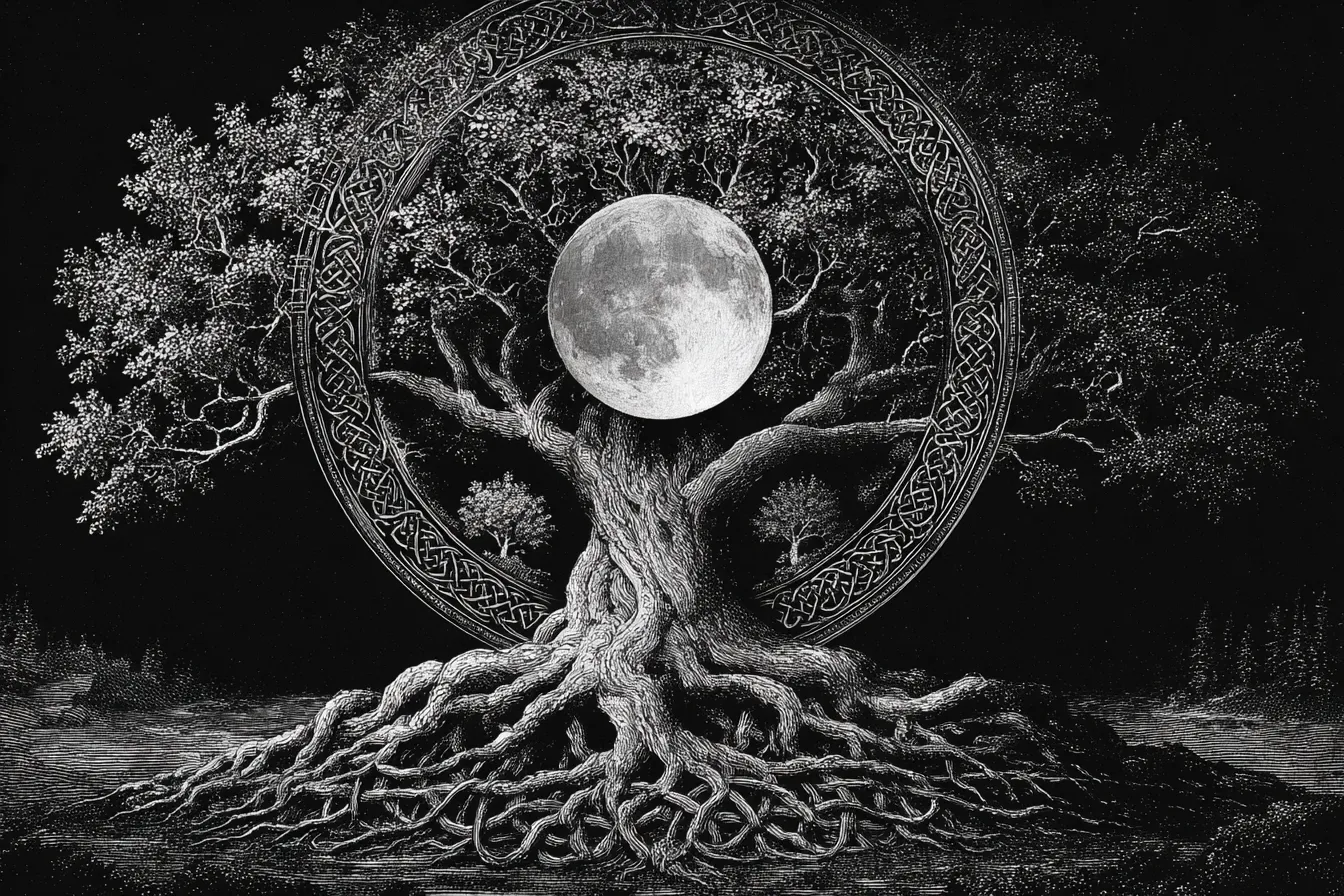
What is the Ivy sign in Celtic astrology?
If your birthday falls between September 30 and October 27, the Celtic Tree Calendar places you under the Ivy — the eleventh tree, the spiral returner, the one that continues when other things have stopped and transforms what it covers rather than consuming it. Its Ogham letter is Gort (ᚋ), the eleventh character in the ancient alphabet inscribed on standing stones across Ireland and western Britain. The name Gort means “field” or “garden” in Old Irish — the letter name is not the plant name, which is itself a small piece of evidence for the interpretive complexity of the Ogham sources. The plant assigned to it in the modern Celtic astrology tradition is the ivy, and the reasoning is sound: the ivy is the most visibly persistent, most spirally growing, most transformation-oriented plant of the deep autumn season that Gort governs.
The Celtic Tree Calendar links each of its thirteen lunar months to a tree whose ecology, mythology, and material life in Ireland and Britain becomes a framework for understanding those born within it. As in every article in this series: the calendar in its modern form draws primarily from Robert Graves’s The White Goddess (1948), synthesising genuine medieval Irish and Welsh sources through Graves’s interpretive lens. It is not a transcript of pre-Christian Celtic practice. The Ogham alphabet is genuinely ancient — stone inscriptions from the 4th through 8th centuries CE — and the symbolic associations draw on real medieval sources. Contemporary Druidry and Celtic spiritual practice engage with this as a living tradition. The Whisper does the same.
The Ivy month begins in late September, after the autumn equinox has passed and the year has committed to its movement toward darkness. By the end of the Ivy month, on October 27, the world in the British Isles is visibly in deep autumn: leaves fallen or falling, light shortening rapidly, the temperature dropping. Four days later, on November 1, comes Samhain — the great Celtic fire festival of the threshold between the living and the dead, the thinning of the veil, the most significant and most powerful of the four fire festivals. The Ivy month is the approach to Samhain, the final deepening before the great threshold.
The tree and its historical roots
Common ivy (Hedera helix) is one of Britain and Ireland’s most significant evergreen native plants — and one of the most persistently misunderstood. The most widely held belief about ivy — that it kills trees — is ecologically incorrect, and addressing this clearly changes the entire symbolic reading of what ivy actually does.
Ivy does not parasitise or strangle trees. Its adhesive pads cling to the surface of bark but do not penetrate living wood; it draws all its nutrition from its own soil roots rather than from its host. Ivy is epiphytic, not parasitic. Studies of ivy-covered trees have found no evidence that ivy coverage harms healthy trees, and some evidence that ivy actually benefits trees by providing thermal insulation that reduces temperature stress. The association of ivy with dying or dead trees comes from the fact that ivy grows most vigorously where the canopy has opened — the dying tree creates the light conditions that allow ivy to flourish. The ivy did not kill the tree. The tree was already dying, and the ivy moved in.
This matters for the symbolic reading because ivy’s relationship to what it grows on is not consumption or destruction — it is transformation. A ruined wall, an abandoned building, a fallen tree: left to itself, ivy moves in and covers it, providing habitat for dozens of invertebrate species in its dense, protective mat of growth, feeding birds with its berries in the depths of winter when almost nothing else is available, sheltering insects preparing for winter in its late-season flowers. The ivy transforms what has been left behind into something living and useful again. This is categorically different from destroying what is there. It is the specific quality of the eleventh tree: the persistence that does not merely survive in difficult conditions but actively transforms them.
The ivy’s spiral growth pattern is one of its most distinctive features, and it connects directly to the most ancient and pervasive symbol in Celtic visual culture. The triple spiral carved into the stones of Newgrange, the passage tomb built approximately 5,200 years ago in County Meath, is the oldest known large-scale expression of a motif that appears throughout Celtic and pre-Celtic art across the British Isles and northern Europe: the spiral, the double spiral, the triple spiral, the endless interlinking spirals of La Tène metalwork. The spiral is not a Celtic invention — it appears in Neolithic art worldwide — but it became the defining formal motif of Celtic artistic expression, and its meaning is consistently associated with the qualities of eternal return, transformation, and the continuity of the living cycle through apparent endings.
The ivy grows in spirals. Its leaves arrange themselves in spiral patterns to maximise light access; its stems wind in spirals around whatever they climb. The ivy’s growth is not the straight vertical reach of the oak or the ash, not the arching horizontal spread of the bramble — it spirals, returning again and again to the same plane at a slightly different point, ascending through repetition rather than through linear progress. This is the ancient Celtic spiral made biological.
The ivy’s ecological role in winter is worth dwelling on separately from its structural properties. The berries of the ivy ripen in December through February — among the last berries to ripen in the British calendar, after everything else has been eaten or has fallen. The ivy is the winter food source of last resort for thrushes, blackbirds, wood pigeons, and several other species. Its late-season flowers — appearing in September and October, during the Ivy month itself — are one of the most important late-season nectar sources for honeybees, bumblebees, and hoverflies preparing for winter. The ivy’s calendar is almost exactly the inverse of most flowering plants: it flowers in autumn and fruits in deep winter, providing precisely when other providers have stopped.
The energy of Ivy
The dominant quality of Gort is the spiral persistence that transforms what it continues through. Not the Holly’s iron holding of full colour against the darkening season — the ivy does not hold unchanged through what it endures. It grows through it, over it, around it, in the spiral pattern of the eternal return. What the ivy passes through, it transforms. What it covers, it does not destroy but makes into something different — something that is alive again in a different way.
The approach to Samhain is the seasonal context that shapes everything else in the Ivy quality. The Ivy month is the final deepening before the great threshold — the month in which the veil is already thinning, in which the world is visibly turning toward its darkest point, in which the Samhain fire is not yet lit but the preparation for it is underway. The Ivy quality is not the Reed’s direct engagement with the Samhain threshold — that belongs to the following month. The Ivy is the approach: the deepening presence with what is ending, the spiral movement that is preparing to pass through the most significant threshold of the year.
The transformation quality is specifically about what happens when the spiral passes through endings. Ivy on a ruined wall is not the wall as it was — but it is also not simply the end of the wall. It is the wall transformed into habitat, the structure that was built for one purpose now serving another, the material of the past incorporated into the living present through the ivy’s spiral persistence. This is different from the Birch’s clearing that makes space for new beginnings — the ivy does not clear. It incorporates, transforms, makes living again what has been left behind.
The late-season flowering and winter fruiting of the ivy carries a quality that is directly relevant to the sign’s character: the ivy provides precisely when other providers have stopped. The bees and the birds that depend on ivy do so specifically in the period when almost nothing else is available. The Ivy quality is the capacity to be of genuine use — to provide genuine nourishment, genuine habitat, genuine sustenance — in the conditions that most other things find prohibitive. Not through extraordinary effort in difficult conditions, but through the spiral persistence of being exactly what the ivy is, in exactly the season when the ivy’s specific gifts are most needed.
Ivy as a birth sign
As a birth sign, Ivy describes a person whose particular gift is the spiral persistence that incorporates what it passes through and transforms what it covers. Not the Birch’s new beginning from bare ground, not the Oak’s sustained full expression — the Ivy’s quality is specifically about what continues through endings, through the places where other things have stopped, through the deep autumn approach to Samhain’s threshold.
People with strong Ivy energy often have a quality that others observe as extraordinary persistence in conditions that have deterred everyone else. This is not stubbornness in the Holly’s iron sense — the ivy does not hold its form unchanged against all pressure. It grows through what it encounters, spiraling through and around obstacles rather than holding against them, arriving at its destination by the persistent spiral route. The difference between Ivy persistence and Holly persistence is the same as the difference between the spiral and the straight line: both arrive, but by fundamentally different means.
The transformative quality in Ivy people manifests as a specific orientation toward what has been left behind, what has ended, what others have moved away from. The ivy does not thrive in the active, well-tended centre of things — it thrives in the abandoned corner, the forgotten edge, the place where something has ended and been left. Ivy people are often the ones who find genuine value and genuine life in what has been given up, who can see the habitat possibilities in the ruin, who bring something living to what has been written off as finished.
The spiral quality carries its own specific gift: the capacity to return to the same territory repeatedly, at a slightly different level, gaining depth through repetition rather than through linear advance. The spiral return is not the same ground covered again — the second pass of the spiral is above or below the first, touching the same angular position in a different layer. Ivy people often find that their deepest understanding of something comes not from the first engagement with it but from the third or fourth — the spiral return to the same territory from a new position, the recognition that what seemed finished had more in it.
The Samhain approach quality gives Ivy people a specific relationship with endings and thresholds. They are often comfortable in the approach to significant transitions in a way that others are not — not because they are unafraid of what lies beyond the threshold, but because the approach to Samhain is their seasonal home. They may be the people in a group who can hold the space of the approaching ending without either rushing toward it or retreating from it — who can be genuinely present in the deepening, in the thinning of the veil, in the accumulation of what the year has contained as it approaches its great threshold.
The Ivy month as a seasonal energy
In The Whisper, the seasonal dimension of the Ivy applies to the calendar period of September 30 through October 27 as an energy active for everyone. The Ivy season is defined by deep autumn and by the approach to Samhain — the final deepening before the year’s great threshold.
The Ivy season carries a specific invitation: the invitation to spiral through what is ending rather than to either hold against it or flee it. The leaves are falling. The light is shortening with unusual speed in October, faster than any other month in the northern hemisphere. The world is visibly moving toward its darkest point. The ivy holds its green. Not because it is in denial of the season — the ivy knows exactly what season it is — but because the evergreen persistence of the ivy through deep autumn is what it is. It provides when others have stopped providing. It transforms the space that endings have made available.
Seasonal position within the Ivy month adds nuance. Those born in early Ivy (September 30–October 8) arrive at the first days of the Celtic autumn proper — the equinox has passed, the commitment to darkness is new. The early Ivy carries the freshest quality of the approach. Those born in the heart of the month (October 9–18) carry the fullest Ivy quality — the deep autumn spiral at its most complete. Those born in late Ivy (October 19–27) are already approaching the Reed threshold, and the Samhain awareness is most directly present here, the veil at its thinnest before the Reed month takes over the threshold directly.
Strengths and growth edges
The strengths of the Ivy are the strengths of the spiral return: the capacity to incorporate what has been passed through, to transform what has ended into something living, to be of genuine use precisely in the conditions where other presences have withdrawn. The late-season flowers that sustain the bees, the winter berries that sustain the birds, the dense cover that provides habitat through the months when the deciduous trees are bare — these are the ivy’s specific gifts, offered precisely when and where they are most needed.
The spiral wisdom is a related strength: the understanding that genuine depth comes through the return to the same territory in a different layer, that the third engagement with something contains what the first could not have reached. Ivy people who have developed this quality have access to a kind of understanding that is not available to those who advance only linearly — the depth of the spiral that has passed through the same ground multiple times.
The growth edges are the shadows of the same qualities. The spiral persistence that grows through what it encounters can become the entanglement that does not release. The ivy in full growth covers everything it touches — this is transformation when it is the ruin’s wall, but it is entanglement when it covers a living tree that needs light and air. The Ivy quality of incorporating and transforming needs to be in relationship with the discernment of what genuinely benefits from the ivy’s covering and what is harmed by it.
The deep autumn orientation can become the preference for the threshold over the living interior. The ivy thrives in the approach to Samhain — but the year continues past Samhain into winter, into the solstice, into the return of the light. The Ivy person who is most alive in the deep autumn approach to the threshold can find the rest of the year — the spring’s new beginning, the summer’s full expression — less available as territory for genuine engagement. The spiral has to pass through the whole cycle, not only the part it finds most natural.
The transformation of endings can also become the gravitational pull toward what has ended over what is still alive. The ivy grows most vigorously where the canopy has opened, where something has left — which means the Ivy quality can orient consistently toward the spaces that endings have made available at the expense of genuine presence in what is still in full growth. The ivy needs living ground as well as the ruin.
What people get wrong about the Ivy sign
The most common misreading of the Ivy sign is as parasitic or co-dependent — the one who attaches to others for support, who cannot stand independently, who drains what it grows on. This comes from the persistent ecological myth that ivy kills trees — a myth that the ecology disproves, but that has shaped the symbolic reading of ivy in much popular writing. If ivy does not kill trees — if it is epiphytic rather than parasitic, transformative rather than destructive — then the entire symbolic reading must shift. The Ivy person is not the one who drains what they are in relationship with. They are the one who transforms what they are in relationship with — who brings something living to what has been left, who provide when others have stopped providing.
The second common error is reading the Ivy as purely dark or death-associated — because of the Samhain proximity, because of the association with ruins and abandoned places, because of the deep autumn context. The ivy’s Samhain orientation is real, but the ivy is also one of the most life-generating plants in the British calendar: it flowers late and feeds bees when almost nothing else is flowering; it fruits in deep winter and feeds birds when almost nothing else is fruiting; it provides the most significant evergreen winter cover for dozens of nesting species. The Ivy is not death-associated. It is the plant that provides life precisely at the threshold of the dark, exactly when providing is most difficult and most needed.
The third misreading treats the Ivy’s spiral quality as circular repetition without progress — going around the same ground endlessly without arriving anywhere. This misreads what the spiral actually is. The ivy’s spiral ascends — each pass of the spiral is above the last, touching the same angular position in a higher layer. The spiral is not the circle. It advances through depth. The Ivy person who appears to be returning to the same territory is gaining altitude with each pass — arriving at the same position with the full weight of every previous circuit already incorporated.
What Ivy means in The Whisper
In The Whisper, when Celtic is active in your oracle stack and your birth sign is Ivy, the system reads your day through the Gort lens: the spiral persistence that transforms what it passes through, the late-season provider in the approach to Samhain’s threshold, the evergreen that covers what has ended with something living.
The Ivy’s calendar month spans the end of Libra and the beginning of Scorpio in Western Astrology — Libra runs until approximately October 22–23, and Scorpio begins from there through the remainder of the Ivy month. The resonance with Scorpio is particularly direct and worth developing fully. Both the Ivy and Scorpio describe the qualities of deep autumn approach to the threshold of what lies beyond ordinary life: the thinning of the veil, the willingness to be present in what is ending without flinching from it, the persistence that continues past the point where lighter orientations have withdrawn. Scorpio’s depth, its comfort with transformation and threshold experiences, its orientation toward the hidden and the continuing — these are the Ivy’s qualities in the Western astrological vocabulary. When The Whisper synthesis draws on both a Scorpio placement and an Ivy birth sign, the reading is often one of unusual coherence: two systems pointing at the same quality of deep, transformative, spiral persistence in the approach to the year’s most significant threshold.
The Libra overlap for early Ivy (September 30–October 22) adds the balance-seeking, connection-oriented quality to the early Ivy person — the spiral persistence with the Libran awareness of what is in relationship.
Runes offer a precise parallel in Isa (ᛁ) — the ice rune, associated with stillness, with the preservation of what continues in the period when everything around it has stopped moving. Isa is often misread as a purely negative or obstructive rune — the ice that stops movement, the freezing that ends things. The more accurate reading is the ice as the condition that preserves what would otherwise decay: the mammoth frozen in permafrost, the seed preserved in the ice until the thaw, the form maintained through the period when nothing can grow. The runes are a Norse and Germanic tradition, distinct from the Celtic Ogham, but Isa’s quality of active, preserving stillness in the season of cessation — the continuing that holds the form through the dark period — is the Ivy’s quality exactly. The ivy does not stop when the deciduous trees shed their leaves. It holds. It provides. It maintains its spiral through the period when other things have withdrawn into stillness. When The Whisper synthesis draws on Isa-resonant runic energy alongside an Ivy birth sign, the reading tends toward the quality of genuine, active persistence: not the refusal of ending but the continuation that holds the form that must be held through the threshold.
In BaZi, the Ivy quality resonates most closely with Ren Water (壬水) — the yang water that flows regardless of obstacles, that finds its way through and around what would stop other elements, that persists through every season without ceasing. Ren Water in BaZi carries the quality of the great river that continues — it does not hold still like the mountain, it does not yield and absorb like Ji Earth; it flows, finds routes, continues through what would dam a lesser water. The Ivy’s spiral persistence — the growth that continues through the deep autumn approach to Samhain, through the conditions that stop other growing things, finding the route through and over and around what stands in the way — is the Ren Water quality in a botanical expression. When The Whisper synthesis draws on a Ren Water day alongside an Ivy birth sign, the reading tends toward the invitation of genuine, flowing persistence: the quality that continues not through force but through the inexhaustible find-the-way-through of water that has nowhere to stop and everywhere to go.
In Numerology, Gort is the eleventh Ogham letter, and the number 11 is the first of the master numbers — the numbers that do not reduce in the usual way and carry an amplified quality of their base meaning. The 11 is associated with the inspired visionary, the one whose perception reaches beyond ordinary seeing to the pattern that underlies it, the spiral-walker who has ascended enough passes to see the whole cycle from above. Where the 2 (to which 11 reduces) is the perceptive witness of what is immediately present, the 11 is the witness who sees the spiral structure of what is present — the pattern that connects past, present, and approach-to-future in the same view. This is the Ivy’s quality exactly: the spiral that returns to the same ground with the full weight of every previous circuit, the vision that sees the pattern of the return rather than only the current position on the spiral. When The Whisper synthesis draws on an 11-resonant numerological day alongside an Ivy birth sign, the reading tends toward the spiral perception — the invitation to see not only where the current position is but the full arc of the spiral that has arrived here, and where the next pass of the spiral will be.
When multiple systems converge on the Ivy quality — the spiral persistence, the transformation of what is covered rather than its destruction, the late-season provision when others have stopped — The Whisper reads it as a signal about the relationship between continuing and transforming. The ivy does not hold unchanged, and it does not consume what it covers. It grows through it, over it, in the spiral of the eternal return, and what it passes through is transformed into something living again. The question the synthesis raises is what, in the current conditions, is asking for this specific quality: not the new beginning, not the full expression, not the harvest, but the spiral presence that continues through endings and transforms what it covers into something that can sustain life again.
Frequently asked questions
Q: Does ivy really not kill trees? This is genuinely true, and it contradicts a very widely held belief. Common ivy (Hedera helix) is epiphytic — it grows on the surface of other plants without penetrating living tissue and draws all its nutrition from its own soil roots rather than from its host. Controlled studies have not found evidence that ivy coverage harms healthy trees, and some research suggests ivy may benefit trees through thermal insulation. The association of ivy with dying trees comes from the fact that ivy grows most vigorously in the conditions created when a tree has died or is dying — the opened canopy lets in the light that allows ivy to flourish. The ivy was not the cause; the opening was. In traditional folklore and much popular writing, this ecological sequence has been reversed, producing the myth of the tree-killing ivy. Correcting it changes the symbolic reading of the Ivy sign significantly: the ivy is a transformer and a provider, not a parasite.
Q: What is the connection between ivy and the Celtic spiral motif? The spiral is the most ancient and pervasive motif in Celtic and pre-Celtic art of the British Isles, appearing most famously in the triple spirals carved into the stones of Newgrange (approximately 3200 BCE) and in the interlinking spirals of La Tène metalwork from the 5th century BCE onward. The ivy grows in spirals — its leaves are arranged in spiral patterns to maximise light access, and its stems wind in spirals as they climb. The connection between the ivy’s growth pattern and the spiral motif of Celtic art is not an explicit claim made in medieval Irish texts; it is a resonance that the modern Celtic Tree Calendar tradition draws on. The Whisper treats it as a genuinely meaningful correspondence rather than a directly attested ancient association.
Q: How does the Ivy sign relate to Samhain? The Ivy month (September 30–October 27) is the approach to Samhain rather than Samhain itself — the festival falls on November 1, which is in the following Reed month. The Ivy’s relationship to Samhain is the relationship of the preparation to the threshold: the deepening approach, the visible thinning of the veil, the world moving rapidly toward its darkest point in the weeks before the festival. The Ivy quality is the capacity to be genuinely present in this approach — not fleeing from it, not rushing toward it, but spiraling through the deepening autumn with the persistence that continues when other things have stopped. Those born in the final days of the Ivy month (October 24–27) carry the Samhain approach quality most intensely, arriving just days before the great threshold.
Q: Why is the Ogham letter named Gort (field/garden) rather than a word for ivy? The etymology of Gort as “field” or “garden” in Old Irish is genuine, and it is one of several Ogham letters whose name does not directly correspond to the plant most commonly associated with it in modern Celtic astrology. The medieval Ogham sources are not always consistent in their plant attributions for each letter, and Graves’s synthesis involved interpretive choices about which plant best fit each letter’s position and seasonal context. The assignment of ivy to the Gort letter draws on the ivy’s seasonal timing (deep autumn, approaching Samhain), its spiral quality, and its evergreen persistence — a set of associations that fits the position even if the etymological derivation does not go directly through the Old Irish word for ivy. The Whisper works with the modern tradition while being transparent about this etymological complexity.
Q: The Ivy is often associated with grief and remembrance — is this part of the sign’s meaning? The association of ivy with grief and remembrance is present in several Western literary and funerary traditions — ivy is commonly found in churchyards and on grave monuments across Britain and Ireland, and the wearing of ivy was associated with mourning in some 19th-century traditions. This association connects to the Ivy’s genuine qualities of the approach to Samhain, of the transformation of endings, of the evergreen persistence in conditions of loss. The Whisper does not reduce the Ivy sign to grief — the late-season provision, the spiral vitality, the transformative rather than mournful relationship with endings are equally central. But the association is genuine and worth understanding: the Ivy’s comfort with the deep autumn approach to the threshold, its capacity to be present with endings without being consumed by them, and its quality of transforming rather than merely surviving what it passes through — these are the source of the funerary association, and they speak to a real dimension of the Ivy’s character.