
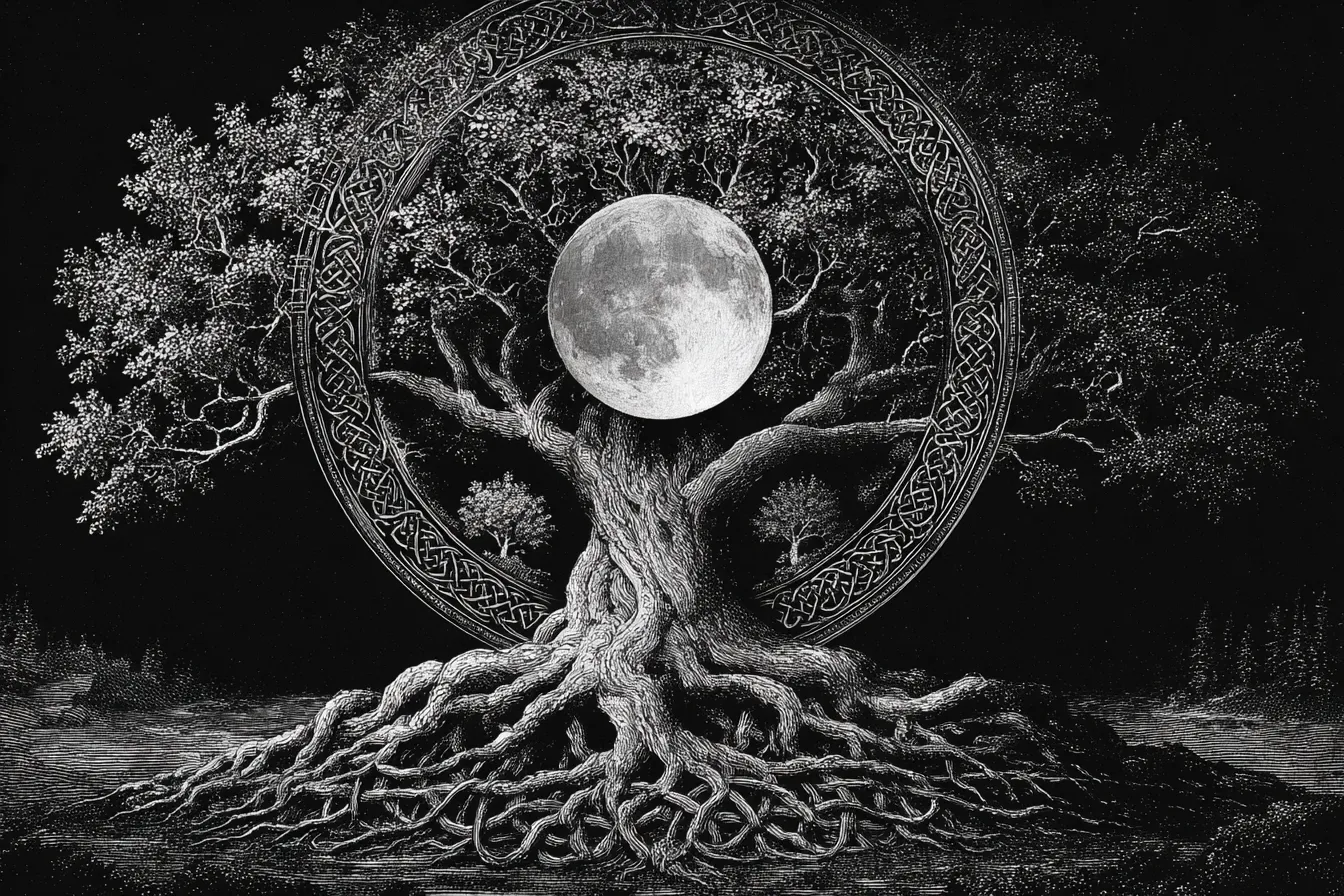
What is the Oak sign in Celtic astrology?
If your birthday falls between June 10 and July 7, the Celtic Tree Calendar places you under the Oak — the seventh tree, the king of the forest, the tree at the apex of the year’s light. Its Ogham letter is Duir (ᚇ), the seventh character in the ancient alphabet inscribed on standing stones across Ireland and western Britain. The Oak month contains the summer solstice — the longest day, the peak of the year’s solar power — and this timing is the Oak’s defining context: the Duir sign arrives not at a beginning or a threshold, but at the fullest expression the year can offer, the moment before the long arc toward darkness begins. To be born under the Oak is to arrive at the peak of everything the year has been building toward.
The Celtic Tree Calendar links each of its thirteen lunar months to a tree whose ecology, mythology, and material life in Ireland and Britain becomes a framework for understanding those born within it. As in every article in this series: the calendar in its modern form draws primarily from Robert Graves’s The White Goddess (1948), synthesising genuine medieval Irish and Welsh sources through Graves’s interpretive vision. It is not a transcript of pre-Christian Celtic practice. The Ogham alphabet is genuinely ancient — stone inscriptions survive from the 4th through 8th centuries CE — and the symbolic associations draw on real medieval textual sources. Contemporary Druidry and Celtic spiritual practice engage with this as a living tradition. The Whisper does the same.
The Oak is the tree most deeply associated with the Druids — the word Druid itself is believed to derive from the same Proto-Celtic root as duir, the oak. The oak-knowers. The people whose wisdom was inseparable from their relationship with the most powerful tree in the forest.
The tree and its historical roots
The English oak (Quercus robur) and the sessile oak (Quercus petraea) are among the longest-lived and most ecologically significant trees in the British Isles. An oak can live for a thousand years or more — several specimens in Britain are estimated at over a thousand years old, and some ancient pollarded oaks may be older still. In those thousand years, a single oak tree can support more than five hundred species of invertebrates — a figure that exceeds that of any other native British tree by a considerable margin. Add the birds, the mammals, the fungi, the lichens, and the mosses that depend on oak, and the total approaches six hundred species. No other native tree in Britain comes close. The oak does not merely live in the forest. The oak is the forest’s centre of gravity.
The oak’s relationship with lightning is documented and genuine: oaks are struck more frequently than most other trees, possibly because of their height, the conductivity of their tannin-rich bark, and their tendency to grow in exposed positions. In the thunder-god traditions of multiple Indo-European cultures — Zeus, Jupiter, Taranis, Thor — the oak is the sacred tree, and this association is not coincidental. The tree that stands highest in the forest, that reaches most fully toward the sky, that accepts the sky’s most powerful discharge without necessarily dying from it, embodies a specific quality: the capacity to receive the full force of what comes from above and to remain standing.
Duir has one of the most debated etymologies in Ogham scholarship. The connection to “door” — Latin durus, Old Irish dair — is genuine in the sense that both words share a Proto-Indo-European root meaning strength or solid wood, and the Irish word for oak, dair, is closely related to the word for door. The oak as gateway or doorway appears in several Celtic and broader Indo-European contexts: the doorway made from the strongest wood, the threshold that holds because it is made from the hardest material. The connection between the oak and the Druids is better attested: the classical source Pliny the Elder, writing in the 1st century CE, describes Celtic Druids as gathering in oak groves, performing mistletoe ceremonies (mistletoe that grows on oak is considered particularly sacred), and taking their name from drys, the Greek word for oak. The etymology of Druid remains debated — the dru-wid reading, “oak-knower” or “great wisdom,” is one reconstruction among several — but the oak’s central role in Druidic practice is documented in multiple classical sources.
There is a specific detail worth dwelling on: the texts in which Celtic mythology, Irish heroic literature, and Druidic lore were preserved through the medieval period — the manuscripts that remain the primary source for everything the Celtic tradition has transmitted — were written in iron gall ink. Iron gall ink is made from oak galls: the small, spherical growths that a gall wasp produces on oak leaves, which contain high concentrations of tannic acid. The texts that preserved the Druid traditions were written in ink made from the Druids’ sacred tree. This is not symbolic — it is the material history of how knowledge survived.
The Oak King and Holly King narrative — the myth of two divine kings who alternate rule of the year, the Oak King reigning from the winter solstice to the summer solstice and the Holly King taking over at midsummer — is worth addressing directly. This narrative is primarily a modern Pagan construct, developed most influentially by Graves in The White Goddess and subsequently adopted widely in Wicca and contemporary Druidry. An ancient, directly attested Celtic version of this specific narrative does not exist. The holly and oak do have genuine ancient associations with the two halves of the year, and the theme of the year’s two great turning points being governed by different forces is present in various Celtic and broader Indo-European contexts. But the specific two-king narrative is a 20th-century synthesis rather than an ancient text. The Whisper names this honestly because the distinction matters — what is genuine ancient material and what is meaningful modern synthesis are both worth knowing.
The energy of Oak
The dominant quality of Duir is full expression at the peak. Not the initiation of the Birch, not the preparation of the Willow, not the threshold-dwelling of the Hawthorn — the Oak’s quality is the sustained, complete, unhesitating expression of everything the year has been building toward. The solstice oak is at the height of its canopy, at the maximum density of its leaf cover, at the fullest possible expression of what an oak can be in a given year. It does not hold anything back.
This is not the same as being at the beginning of something. The Oak is not the first movement or the pioneer. The Oak arrives at the peak of a long build — and the quality that defines it is the willingness to be fully and completely itself at the moment of maximum expression, without diminishment, without apology, without the self-protective reduction that holds back the full weight of what it is.
The lightning quality is as important as the crown. The oak receives what comes from the sky — the full discharge of the thunder god’s attention — and it does not die from it. It may be scarred; it may lose a limb; but the oak that has been struck by lightning and survived tends to persist for centuries more, marked but standing. This is not invulnerability — the oak feels the strike. It is the specific quality of a tree that has the structural density to absorb what would split a lighter wood and to continue.
The support of many lives is the other dimension of Oak’s character. Five hundred species of invertebrates are not incidental passengers on an oak tree — they are genuinely supported by it, dependent on it, made possible by its presence. The Oak’s expression of itself creates the conditions for an extraordinary diversity of other lives. This is not a sacrifice — the oak is not giving up its own growth to support others. It is the natural consequence of being fully what it is: the full expression of oak-ness generates conditions that support what could not exist without it.
The solstice timing introduces the essential complexity of the Oak sign: the peak of the year is also the turning point. The summer solstice is the longest day — and the day after it is shorter than the day before it. The Oak’s moment of full expression is simultaneously the moment when the year begins its long arc toward darkness. The Oak knows this. The Druids in their groves at midsummer knew this. The quality of the Oak sign is not the naive confidence of someone who has not yet seen the turning — it is the full expression of someone who knows that the peak is also the threshold, and who chooses full expression anyway.
Oak as a birth sign
As a birth sign, Oak describes a person whose particular gift is being fully, sustainably, completely themselves at the moment of maximum expression. Not the explosive Beltane fullness of the Hawthorn, which is intense and brief — the oak’s fullness is sustained over centuries. The Oak person’s quality of full self-expression is not a peak that passes; it is a sustained, structural presence that generates conditions for others over long time.
People with strong Oak energy often carry a gravitational quality — not dominance or aggression, but the kind of natural centrality that a large, old oak tree has in a landscape. Other things orient around it. The six hundred species that depend on a single oak are not consciously choosing to orient around it; they are simply responding to the conditions it creates. The Oak person often finds that others gather around them, depend on them, or orient their own choices in relation to the Oak — not because the Oak person has sought this role but because the full expression of who they are generates that quality of centrality.
The longevity and endurance quality is central to understanding the Oak birth sign. The oak’s strength is not the quick strength of the fast-growing birch or the precise hardness of the hawthorn’s thorns. It is the deep, dense, accumulated strength of slow growth over long time. The oak at one hundred years is not as impressive as the oak at five hundred years, which is not as impressive as the oak at a thousand. The Oak person’s capacities tend to deepen and strengthen over time rather than peaking early. They are frequently more themselves at fifty than they were at twenty, more at seventy than at fifty.
The solstice quality — full expression that also carries the knowledge of turning — gives Oak people a specific relationship with completeness and continuation. They tend to be able to be fully present in the peak of things without the anxiety that the peak will pass, because they understand at some level that the turning is not failure — it is the natural consequence of having been fully at the peak. The tree does not mourn the solstice passing; it continues, in its full expression, through the turning.
The Oak month as a seasonal energy
In The Whisper, the seasonal dimension of the Oak applies to the calendar period of June 10 through July 7 as an energy active for everyone. The Oak season is defined above all by the summer solstice — the longest day, the peak of the year’s solar power, the moment when the light is at its maximum before the arc toward darkness begins.
The Whisper reads the Oak season as a period of invitation toward full expression: the invitation to be completely, sustainably what you are, without the self-protective reduction that holds back the full weight of expression. The Oak month is not the time for building toward something or for preparing — it is the time to be at the fullness of what has been built.
Seasonal position within the Oak month adds nuance. Those born in early Oak (June 10–20) arrive in the days just before the solstice — the crown is at full density, the light is at its peak, and the turning has not yet happened. There is a particular quality of fullness-before-the-turn in early Oak births. Those born at or near the solstice itself (June 21–25) carry the solstice quality most directly: born at the exact peak, which is simultaneously the exact beginning of the turning. Late Oak births (June 26–July 7) carry the Oak quality with the turning already in progress — the light is beginning its arc toward darkness, and the Oak’s sustained expression continues through that knowledge.
Strengths and growth edges
The strengths of the Oak are the strengths of genuine, sustained, structural depth. The capacity to be fully oneself without holding back, to support many other lives as a natural consequence of full self-expression, to receive what the sky delivers — including what is difficult and discharging — and to continue standing, marked but not destroyed — these are rare and genuinely powerful qualities. The oak’s longevity is not mere persistence. It is the specific consequence of being built, over long time, in a way that becomes more structurally sound rather than less.
The natural centrality that comes with full Oak expression is a related strength: the conditions the Oak creates for others are not a strategic choice but the natural consequence of being fully what it is. The Oak person who understands this can stop worrying about whether they are doing enough for those who orient around them and trust that the full expression of their own nature is, itself, the contribution.
The growth edges are the shadow of the same qualities. The Oak’s fullness and centrality can become the assumption that one’s perspective encompasses the whole. The oak in full leaf creates shade that prevents other things from growing directly beneath it — this is the shadow of the very quality that makes the oak what it is. The Oak person’s full self-expression can, at its growth edge, shade out other expressions that are equally valid but require different conditions. The king of the forest whose shadow covers too much ground has, without intending to, reduced the diversity it once supported.
The solstice awareness — knowing that the peak is also the turning — can become, in its growth edge, a difficulty with genuine rest in the fullness of things. If the Oak person is always aware that the turning is coming, the capacity to be fully present at the peak — to not pre-emptively begin the arc downward before it is time — requires deliberate cultivation. The oak does not diminish at the solstice; the diminishing comes gradually, over months. The Oak’s wisdom is to be fully at the peak for as long as the peak lasts, not to leave the peak before it passes.
The longevity quality can also become a growth edge when it expresses as resistance to the turnings that are actually necessary. The ancient oak that has survived lightning strikes and storms for a thousand years carries genuine wisdom of endurance. But some turnings are not obstacles to be withstood — they are genuine transitions that require the Oak to engage with what is changing rather than continuing unchanged. The Oak’s strength is real; the question is whether that strength is being applied in service of genuine continuation or in resistance to genuine transformation.
What people get wrong about the Oak sign
The most common misreading of the Oak sign is as dominance or authority-seeking — the natural leader who assumes control, the one who needs to be in charge, the person who cannot tolerate not being at the centre. This misreads what the Oak’s centrality actually is. The oak does not pursue centrality — five hundred species do not gather around an oak because the oak has positioned itself strategically. They gather because the oak, in being fully what it is over long time, has created the specific conditions that make their lives possible. The Oak sign’s natural centrality is the consequence of deep self-expression, not the goal of it.
The second common error is treating the Oak as invulnerable — the one who can handle anything, who does not need support, who is so structurally sound that difficulty does not affect them. The oak that has been struck by lightning is marked by it. The density of oak wood is the product of slow, sustained growth in conditions that include difficulty — not the product of immunity to difficulty. The Oak person’s capacity for endurance does not mean they do not feel what strikes them. It means they have the structural depth to continue after being genuinely struck.
The third misreading is of the Oak’s solstice quality as static triumph — the one who has arrived at the peak and stays there, unchanging, complete. The solstice is the turning point as well as the peak. The oak continues through the turning, fully itself in the diminishing light as well as the growing light, through summer’s fullness and autumn’s shedding and winter’s bare structure. The Oak sign describes a person who is fully themselves at every stage of the cycle — not one who lives permanently at the solstice high point.
What Oak means in The Whisper
In The Whisper, when Celtic is active in your oracle stack and your birth sign is Oak, the system reads your day through the Duir lens: the king of the forest at the peak of the year’s light, the sustained full expression that generates conditions for many lives, the capacity to receive what the sky delivers and to continue.
The Oak’s calendar month spans the end of Gemini and the beginning of Cancer in Western Astrology, with the summer solstice marking the Cancer ingress in most years. The resonance between Oak and Cancer is genuine and rich: both describe a quality of protective, deeply-rooted, nurturing centrality. The Cancerian quality of the home as the centre that makes other lives possible, of the protective shell that holds what is most essential, of the deep emotional root system that sustains what grows above it — these are the Oak’s qualities translated into the relational and emotional register. Where the Oak expresses its centrality through structural presence and the conditions it creates, Cancer expresses the same quality through emotional depth and the sustaining of what is held close. When The Whisper synthesis draws on both a Cancer placement and an Oak birth sign, the reading often concerns the relationship between the outward structural expression and the inward emotional root — the full expression of both as inseparable aspects of the same deep quality.
The late-Gemini overlap for those born in early Oak (June 10–20) adds a different layer: the Gemini quality of communication and connection alongside the Oak’s fullness tends toward the expression of what the deep wisdom actually is — finding the words for the depth, bringing the Oak’s accumulated knowing into articulate form.
Runes offer a significant parallel in Sowilo (ᛊ) — the sun rune, associated with the victory of full solar expression, with the peak of the year’s power, with the light that is complete in itself. The runes are a Norse and Germanic tradition, distinct from the Celtic Ogham, but Sowilo’s quality of solar fullness — the wheel of the sun at its maximum, the rune associated with success, with the full expression of force in its proper direction — corresponds directly to the Oak’s solstice quality. There is also resonance with Eihwaz (ᛇ) — the world-tree rune, associated with the yew primarily in Norse tradition but carrying the axis quality, the tree that stands at the centre of things and connects what is above and below. When The Whisper synthesis draws on Sowilo-resonant runic energy alongside an Oak birth sign, the reading tends toward the invitation toward full, unhesitating expression of what has been built — the solstice moment when the year’s accumulated growth is at its maximum.
In BaZi, the Oak quality resonates most powerfully with Jia Wood (甲木) at its fullest expression — the tall, straight, fully expressed yang wood that grows with its nature rather than around obstacles, that stands completely itself in every season. The Jia Wood quality in BaZi describes someone of direct, principled, fully expressed character — not the flexible complexity of Yi Wood, not the yielding intelligence of Gui Water, but the direct, tall, unhesitating quality of the tree that grows toward the sky because that is what it does. When the Whisper synthesis draws on a Jia Wood day alongside an Oak birth sign, the reading is often one of unusual coherence: the day’s energy and the birth sign’s quality pointing in the same direction of full, direct, unmediated self-expression. The reading tends toward the question of what specifically that expression is asking to be brought to full height.
In Numerology, Duir is the seventh Ogham letter, and the number 7 carries the quality of the deep seeker — the contemplative, the one who goes into the interior of things to find what is actually there, the philosopher and the wisdom-seeker. The Druid under the oak is the number 7 exactly: the practitioner of deep knowing, the student of the world-tree, the one whose wisdom is accumulated through genuine inquiry over long time rather than received as a fixed inheritance. The 7 is associated in many numerological traditions with the scholar, the mystic, the one who seeks understanding for its own sake. When The Whisper synthesis draws on a 7-resonant numerological day alongside an Oak birth sign, the reading tends toward the relationship between accumulated wisdom and its expression — the Druid who has spent long years in the oak grove and is now ready to bring what was learned there into the world.
When multiple systems converge on the Oak quality — the full sustained expression at the peak, the natural centrality that generates conditions for many lives, the solstice awareness that the peak and the turning are the same moment — The Whisper reads it as a signal about the relationship between fullness and continuing. The oak at midsummer is not preparing for something else. It is being, fully, what it is. The question the synthesis raises is whether that quality of full, unhesitating presence — without reduction, without self-protective diminishment, without pre-emptive turning before the turn is due — is available to you in the current moment, and what would be expressed if it were.
Frequently asked questions
Q: Does “Druid” really mean “oak-knower”? The etymology of Druid is genuinely debated among scholars, but the oak connection is real. The most widely cited reconstruction derives the word from Proto-Celtic dru-wid-s, combining a root related to the oak (dru-, cognate with the Greek drys, oak) with a root meaning “to know” or “to see” (wid-, also present in Latin videre and Sanskrit veda). This would give “oak-knower” or, more loosely, “one who knows the oak’s wisdom.” Alternative reconstructions derive dru- from a prefix meaning “very” or “great,” giving “great wisdom.” Both readings preserve the oak connection in some form. What is better attested than the etymology is the practical association: classical sources including Pliny the Elder explicitly describe Celtic Druids gathering in oak groves and treating the oak as their primary sacred tree.
Q: Is the Oak King and Holly King myth genuinely ancient Celtic? Not in the specific form in which it is widely known. The narrative of two divine kings — the Oak King ruling the waxing year from winter to summer solstice, the Holly King ruling the waning year from summer to winter solstice — is primarily a modern Pagan construction, developed most influentially by Robert Graves in The White Goddess (1948) and subsequently adopted in Wicca and contemporary Druidry. The holly and oak do have genuine ancient associations with the two halves of the year, and themes of seasonal kingship and sacrifice appear in various Celtic and broader Indo-European contexts. But the specific two-king narrative as a single, coherent myth is a 20th-century synthesis rather than an ancient text. The Whisper treats it as a meaningful modern construction with genuine traditional roots, rather than as ancient fact.
Q: Why does the Oak month contain the summer solstice rather than being centred on it? The Celtic Tree Calendar’s lunar structure does not align precisely with the solar events of the year — the solstices and equinoxes. The summer solstice falls around June 21, approximately twelve days into the Oak month (June 10–July 7). This means the solstice is close to the beginning of the Oak’s period rather than centred within it, and the Oak month then continues for another two weeks after the turning. In The Whisper, this is read as follows: the Oak month begins just before the solstice peak, carries the full expression of the solstice, and then continues through the first period after the turning — the Oak sign encompasses both the fullness of the peak and the first movement of continuation after it.
Q: The Oak is said to support more species than any other British tree — is this genuinely true? Yes, and the figures are striking. The ecological research on British native trees consistently places oak at the top for biodiversity support. Studies by entomologist Keith Alexander and others have documented over 500 species of invertebrates associated with oak — a figure that substantially exceeds that of any other native species. When you add fungi, lichens, mosses, birds, and mammals that are closely associated with oak, the total approaches 600 species or more. The ancient, veteran oaks — trees of several hundred years — support particularly high biodiversity because of the specific habitats they create: dead wood, cavities, deep bark fissures, the particular light conditions under a mature oak canopy. This is the ecological basis for the cultural association of the oak with the king of the forest: it is literally the tree around which the most life organises itself.
Q: How does the Oak sign relate to leadership? The Oak’s relationship with leadership is worth understanding carefully, because it is not the leadership of authority or command. It is the leadership of the tree that, in being fully itself over long time, creates conditions that make many other lives possible. This is a form of leadership that does not require a formal role or an explicit position — it operates through the quality of full self-expression and the conditions that expression generates. Oak people often find themselves in leadership roles not because they have sought them but because the gravity of their full presence has drawn others to orient around them. The development of this quality involves learning to express it deliberately rather than accidentally, and to understand the responsibility that comes with being the tree that five hundred species have built their lives around.